
Test the water before you size anything
Treatment equipment is picked to match a result: hardness, iron, chlorine taste, sediment or something else. Without that result, you are guessing, and a guessed system either under-treats or wastes salt and water.
We do not know the hardness of the water at your address, and we will not state a number. Water in Eagle, ID comes from Veolia Water Idaho, the City of Eagle's own system or a private well, depending on where you live. Ask your water utility for its annual water quality report, or test your tap, before you shop.
- Find out who supplies your water: Veolia Water Idaho, the City of Eagle or your own well.
- Request the latest annual water quality report, or send a tap sample to a lab.
- Note what you actually notice: spots on glass, scale on faucets, a metallic taste, a smell.
- Bring the result to a plumber and match equipment to it.
Neighborhood name does not set your supplier.
Your address decides who serves you, not the subdivision. A home in Two Rivers or Banbury Meadows still needs its own check, because Veolia Water Idaho, the City of Eagle and private wells all operate in and around Eagle.
Softener, filter or reverse osmosis: which problem does each solve
These three get mixed up all the time. Each one treats a different problem, and a home may need more than one.
| Type. | Treats. | Does not treat. | Where it goes. |
|---|---|---|---|
| Water softener. | Hardness minerals that cause scale. | Chlorine taste, most bacteria. | Main line, whole house. |
| Sediment or carbon filter. | Grit, chlorine taste and odor. | Hardness. | Main line or single tap. |
| Reverse osmosis. | Dissolved solids at the drinking tap. | Whole-house scale. | Under the kitchen sink. |
| Iron or specialty filter. | Iron and similar stains. | Hardness unless paired. | Main line. |
A common mistake is buying a softener to fix a taste problem. A softener swaps hardness minerals for sodium or potassium and does little for chlorine taste.
Why hard water matters to water heaters and fixtures
Scale builds up inside water heaters, tankless units and fixtures when the water carries minerals. A tank heater collects sediment at the bottom, and a tankless heater can scale its heat exchanger, which is why tankless water heater owners pay attention to this topic.
If the hot side of your house shows more scale than the cold side, the heater is where minerals drop out. Tell your plumber what you see. Planning a new heater? Our page on water heater installation covers how treatment fits in.
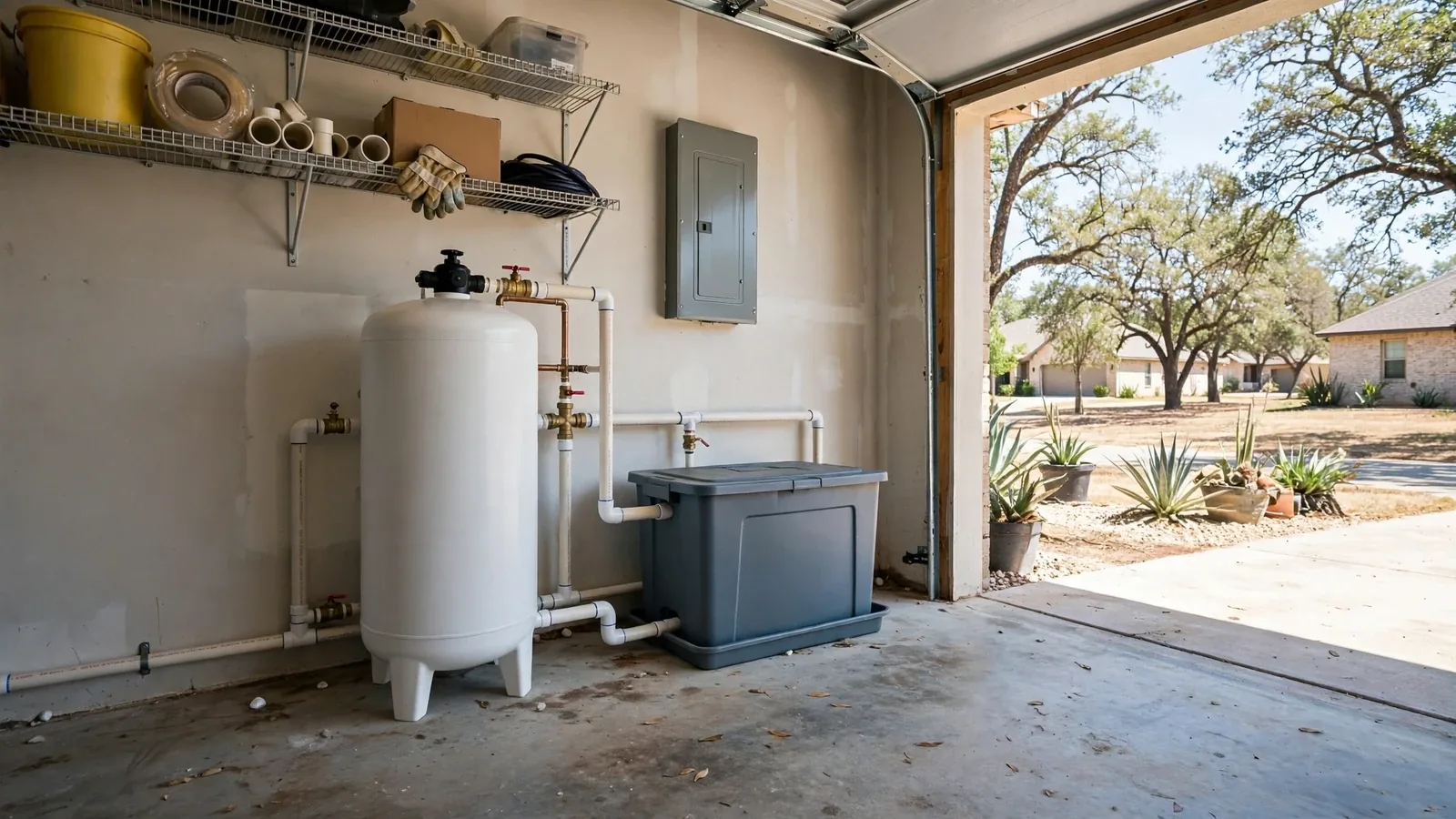
How a water softener installation works
Pick the spot.
The softener goes on the main line after the shutoff and the outdoor spigot tee, with room for a drain and a power outlet.
Size to the home.
Capacity is matched to household size and measured hardness, using the test result you collected.
Set the bypass.
A bypass valve lets you isolate the softener for service without losing water.
Run the drain line.
The regeneration cycle flushes brine to a drain, which needs an air gap and a proper connection.
Program and test.
We set the valve head, run a regeneration and check the water on both sides.
Plumbing permits here come from the state Division of Occupational and Professional Licenses (DOPL) and not the city. Whether your project needs one is a question for DOPL at 208-334-3233. A homeowner may buy a permit for their own home only.
Water conditioner repair and the parts that wear
An older softener rarely fails all at once. It loses capacity, runs out of soft water earlier, or leaves salt sitting in the tank.
- Salt bridge: a hard crust in the brine tank that keeps salt from dissolving.
- Brine well or line clog: the unit cannot draw brine, so it never regenerates properly.
- Worn valve head or seals: water leaks at the valve or the drain runs constantly.
- Exhausted resin: the beads that capture hardness no longer hold it.
- Timer or control board fault: the cycle never starts.
Valve replacement or a resin change is often worth doing on a unit with a sound tank. If the tank itself is cracked or corroded, replacement is the cleaner answer.
Under-sink RO and whole-home filtration in Eagle, ID
An under-sink reverse osmosis system cleans water for drinking and cooking at one faucet. It needs a drain connection at the kitchen sink and a place for a small storage tank, and the filters need to be changed on the maker's schedule.
Whole-home filtration, such as a carbon tank, handles taste and odor for every tap. The Shores has a community water system, for example, so ask your supplier or association which system serves your address before you choose equipment. The same advice holds for a home in Star, where Star Sewer & Water District runs its own water delivery system.
What drives the cost of water softener and filtration work
What shapes the price.
- Equipment type and capacity. A small under-sink RO costs far less to install than a whole-house softener with a large resin tank.
- Water test results. High hardness or iron calls for more capacity or an extra stage, which changes the equipment list.
- Location and drain access. A softener near a floor drain and an outlet is simple. A long drain run or a finished garage adds labor.
- Plumbing modifications. Cutting into the main, adding a bypass and adding an air gap are part of a proper install.
- Service and salt supply. Salt, filters and resin changes are ongoing costs that depend on the system you choose.
Water treatment is planned equipment, so insurance does not usually pay for it. If a softener later leaks and floods a room, that sudden damage is a question for your policy, while wear and gradual leaks are commonly excluded.
Your water test and the space around the main line shape the price. Contact (208) 679-8357 for a clear price before work starts.
Common questions
How hard is the water in Eagle, ID?
We do not know the hardness at your address, and it can change by supplier. Ask Veolia Water Idaho, the City of Eagle or your well tester for the numbers.
Do I need a water softener, a filter or both?
It depends on the test. A softener treats hardness, a filter treats sediment or taste, and RO treats drinking water at one tap.
Can you give an under-sink RO quote over the phone?
We can describe the install and the parts over the phone. The final price depends on the kitchen sink layout and the system you pick.
What is a brine well and why does it clog?
The brine well is the pipe in the salt tank that draws brine to the resin tank. Salt crusts or debris can block it, and then the unit cannot regenerate.
Can a softener valve be replaced instead of the whole unit?
Often yes, if the tank and resin are sound. We check both before recommending a valve or a replacement.
Does a softener affect my tankless water heater?
Softened water can reduce scale buildup in a tankless unit. Check the maker's manual for water quality limits that apply to your model.
If you have a water test result and a question about treatment in Ada County, call (208) 679-8357 and a licensed plumber will answer it.
Call (208) 679-8357Standards and sources
Plumbing work in Idaho follows the state plumbing code, which is based on the 2015 Uniform Plumbing Code (UPC) with state amendments in IDAPA 24.39.20. Permits and licenses come from the Idaho Division of Occupational and Professional Licenses (DOPL), not the city.
- Veolia Water Idaho 2024 annual report (Idaho PUC) (utility filing)
- Idaho DOPL plumbing FAQs (state agency)