
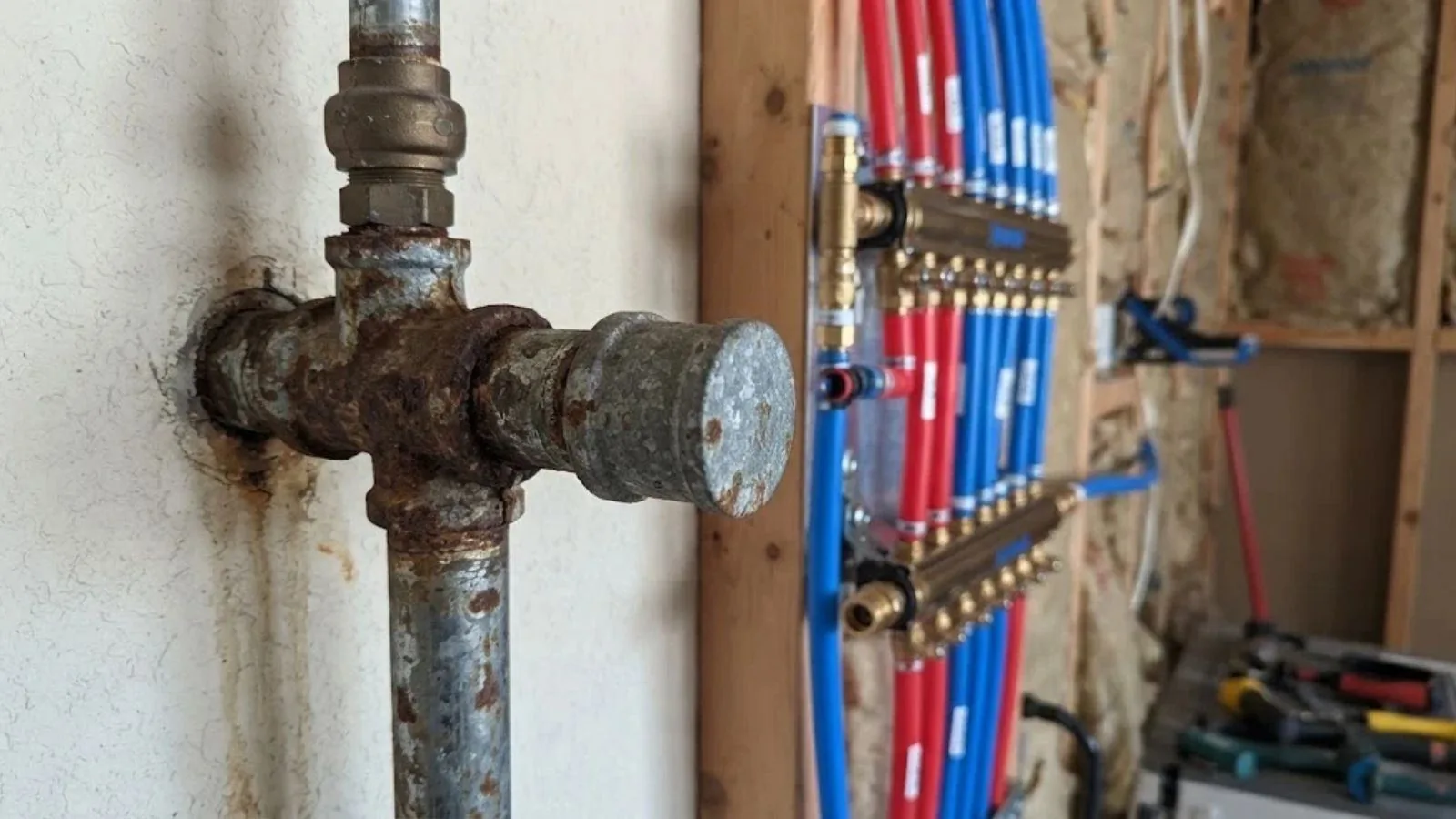
Patch it or repipe it: how the decision gets made
One pinhole in a copper line is a repair. Three pinholes in two years, in different rooms, is a pattern. The pipe wall is thinning along its whole length, and each patch only buys time until the next weak spot gives way.
A repipe usually makes sense when the same kind of failure keeps showing up, or when the pipe itself is the problem and not just one joint. These are the signs we weigh together.
- Leaks in more than one spot, repaired in different years.
- Rust-brown water at the tap that does not clear after a minute of running.
- Pressure that is fine at the hose bib but weak at upstairs fixtures.
- Green crust or white mineral buildup on exposed pipe and fittings.
- Stains or soft spots on drywall near a supply line you have already patched.
If only one of these shows up, a spot repair is often the honest answer, and a burst pipe repair may be all you need. If three or four do, the conversation changes.
What the plumber checks before recommending a repipe
We start with a pressure gauge on an outdoor spigot to see what the house is receiving. Then we compare it with the pressure at a fixture upstairs. A big drop between the two points to restriction inside the pipe, which is typical of old galvanized steel.
Next comes a look at the pipe itself. Where a section is accessible, we check the wall thickness and the inside surface, because corrosion shows more on the inside than the outside. A moisture meter and acoustic listening equipment help us find where a hidden line is weeping, so we are not guessing about which wall to open.
We also tell you what we cannot see. If the main shutoff is stuck or the supply from the street is the weak link, new house pipe will not fix it. That part belongs to your water utility, so ask where its responsibility ends, and see our page on water line repair for the yard side.
Copper, PEX, CPVC and galvanized: what each one does
Here is a plain comparison of the four materials we see inside houses, so you know what you have and what you might replace it with.
| Material. | Where it turns up. | Typical trouble. | Repipe view. |
|---|---|---|---|
| Galvanized steel. | Older homes. | Rusts from the inside, pressure drops. | Usually replace the whole run. |
| Copper. | Many decades of homes. | Pinholes, pitted walls, failed joints. | Replace when pinholes keep returning. |
| CPVC. | Newer plastic systems. | Can turn brittle and crack at fittings. | Replace sections that crack repeatedly. |
| PEX. | Modern repipes. | Damaged by sunlight, bad crimps. | Common choice for the new lines. |
PEX bends around corners, so it needs fewer fittings and often fewer openings in the wall. Copper is still a fine choice when a home already has it and the pipe is sound. Which one fits your house depends on access, the existing lines and what your plumber finds.
Older homes in Garden City and across Eagle, ID
Garden City grew from 764 people in 1950 to 4,571 in 1980, so a lot of its housing dates from the postwar decades through the 1980s. Houses from that stretch are the ones where we check first for galvanized steel or aging copper. If you are buying in Garden City, that age check belongs in your inspection plan.
Older homes in Eagle, ID, such as those around Downtown Eagle and Heritage Park, deserve the same look. We do not assume what is in any house, anywhere in Ada County. A home built in the 2000s, like many in Two Rivers, more often needs one failed line fixed than a whole new system, and we look for that single failure first.
Pipe wear, water chemistry and what we cannot tell you
Water chemistry can speed up corrosion in some systems. We do not know the chemistry at your tap, and we will not guess. Water in Eagle comes from Veolia Water Idaho, the City of Eagle's own system, or a private well, depending on the address.
Ask your supplier first.
Ask your water utility for its annual water quality report, or have your tap water tested if you are on a well. That report tells you more about why pipes fail in your house than any rule of thumb we could offer. Bring it to the repipe conversation.
How a repipe goes, from permit to pressure test
Most whole-house repipes are done in stages so you are not without water for long. Your plumber will tell you what to expect on your house, and you should ask about drywall patching and paint, which are often separate trades.
Walk the house.
We trace every supply line, mark the shutoffs and pick the new routes.
Pull the permit.
Idaho plumbing permits come from the state Division of Occupational and Professional Licenses (DOPL), not the city.
Run the new lines.
We shut water off at the main, cut small access openings and run the new pipe fixture by fixture.
Pressure test.
The new system is tested for leaks before anything is closed up.
Inspection and restore.
DOPL inspections are requested by phone or online, and we reconnect fixtures once the work is approved.
Homeowners may buy a DOPL plumbing permit for work on their own home, but not for a commercial building. A city or county building permit does not replace it. Permit rules vary, so ask DOPL at 208-334-3233 if you plan to do any of the work yourself.
What drives the cost of a repipe
What shapes the price.
- House size and fixture count. More bathrooms, more kitchens and more hose bibs mean more pipe and more connections to make.
- Access to the walls. Open crawlspaces and attics are quick. Finished plaster walls and slab floors take longer.
- Pipe material. PEX, copper and CPVC differ in material cost and labor time, and your plumber will explain the trade-offs.
- Permit and inspection. A DOPL permit and inspection are part of a legal repipe, and they add a visit to the schedule.
- Repair work after the pipe. Drywall, paint and flooring around the openings may be priced apart from the plumbing.
A planned repipe is rarely an insured event. Coverage tends to apply when a pipe bursts and floods a room, and it tends to stop short of wear, slow leaks and the old pipe itself. Read your policy before you count on any help.
Every house routes its pipes differently, so the figure begins with your floor plan. Speak with dispatch at (208) 679-8357 for a clear price before work starts.
Common questions
How do I know if I need a whole house repipe in Eagle, ID?
Look for the pattern, not one leak. Repeated pinholes, rusty water, and weak pressure at several fixtures all point toward the pipe itself. A pressure gauge and a look at accessible pipe settle it.
Is galvanized pipe always a reason to repipe?
Not always, but it rusts from the inside and narrows over time. If pressure is acceptable and nothing leaks, you can plan the repipe instead of rushing it.
Is it worth replacing CPVC pipe before it fails?
CPVC can turn brittle with age. If you have had cracks at fittings more than once, replacing the run is reasonable. If it has never leaked, we check the fittings and tell you what we see.
Can I repipe my own home in Eagle?
Idaho lets homeowners do their own plumbing on a primary or secondary residence if they buy a DOPL permit. It does not apply to commercial buildings. Permit rules vary, so ask DOPL before you cut anything.
What is the water like where I live, and does it affect my pipes?
We do not know the water chemistry at your address. Ask your water utility, Veolia Water Idaho or the City of Eagle, for its annual water quality report, or test your tap if you use a well.
Do landlords and property managers get repipe work done?
Yes. Call with the unit address and what the tenant reported, and we can plan the work around occupied units.
If your pipes are leaking, rusting or losing pressure, call (208) 679-8357 and we will tell you if a repipe is the right fix.
Call (208) 679-8357Standards and sources
Plumbing work in Idaho follows the state plumbing code, which is based on the 2015 Uniform Plumbing Code (UPC) with state amendments in IDAPA 24.39.20. Permits and licenses come from the Idaho Division of Occupational and Professional Licenses (DOPL), not the city.
- Idaho DOPL plumbing FAQs (state agency)