
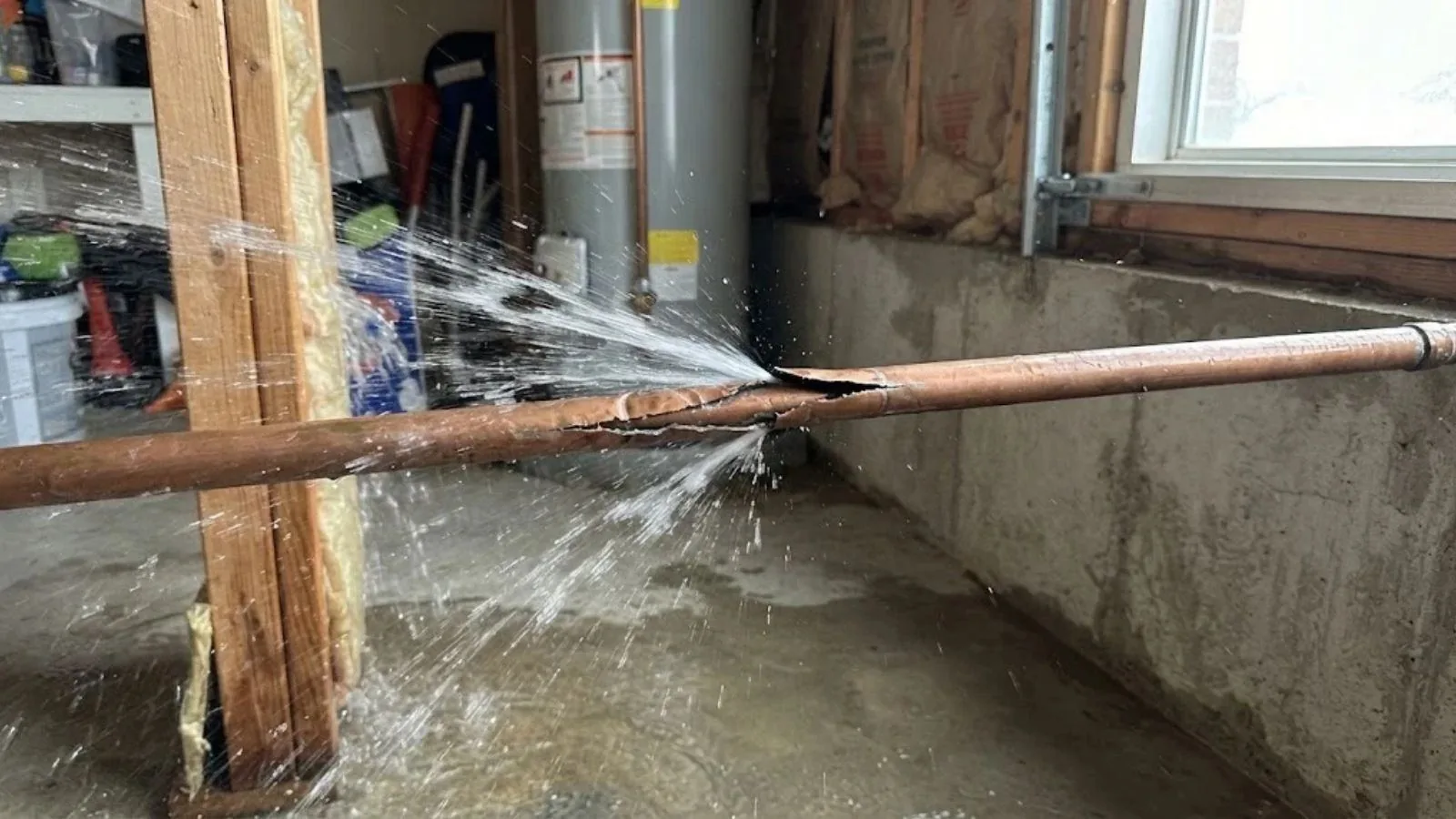
When a burst pipe is an emergency
Water that sprays, pours through a ceiling or soaks drywall is an emergency, so call right away. A slow drip at a fitting can often wait for a same-day appointment when available, but a split pipe under line pressure can put gallons into a house every minute. For scale, the EPA says the average household leak wastes more than 9,300 gallons a year, and that figure covers small leaks, not bursts.
- Water sprays or pours from a pipe, a fitting or a wall.
- A ceiling bulges, stains or drips when nothing is running upstairs.
- Every faucet loses pressure at once.
- You hear rushing water inside a wall with all fixtures off.
- A pipe in the garage or on an exterior wall is split, bulging or coated in ice.
While you wait for us.
Close the main shutoff valve fully. It is usually where the line enters the house, near the water heater, in a utility room or in the garage. Then open the lowest faucet in the house to drain the pipes and relieve the pressure.
Keep everyone out of rooms where water is near outlets, a light fixture or the electrical panel. Lift rugs and electronics out of the wet area and photograph the damage for your insurer. Do not climb into a flooded crawl space or push on a bulging ceiling.
Which shutoff is yours and which belongs to the utility
The valve at the meter box and the meter itself belong to your water supplier. In Eagle, ID that may be Veolia Water Idaho, the City of Eagle's own water system, or a private well, depending on the address. If your own valve is stuck or leaks past the stem, tell the dispatcher, and we will say whether to ask your utility to close the water at the meter. On a private well, switch off the pump breaker instead.
Do this test once a year, before you ever need it. Turn the main valve closed and open, and make sure it moves all the way. Old multi-turn gate valves seize from mineral buildup and break off in your hand, which is a bad surprise during a flood.
How we find the break and what gets repaired
Once the water is off, we find the failure before cutting anything. A pressure gauge on a hose bib shows whether the system holds pressure, a moisture meter maps the wet drywall, and acoustic listening gear picks up the hiss of a pressurized leak inside a wall. Then we make the smallest opening that gets us to the pipe, usually a patch of drywall, not a whole wall.
The repair depends on what the pipe is made of. This table shows the common supply materials and how each one tends to fail.
| Pipe. | How it usually fails. | Usual repair. |
|---|---|---|
| Copper. | Pinholes, freeze splits, failed solder joints. | Cut out the bad section and sweat in new copper or use press fittings. |
| PEX. | Splits at fittings, kinks, sun damage, freeze expansion. | Cut and replace with crimp or expansion fittings. |
| CPVC. | Brittle cracks at fittings, often with age. | Replace the cracked section and fitting. |
| Galvanized steel. | Internal corrosion, splits at threads. | Replace the section and transition to copper or PEX. |
| Valves and connectors. | Cracked bodies, worn stems, failed braided lines. | Replace the part. |
If the same line has failed twice, a patch is the wrong answer. We will tell you when a longer run needs repiping instead of another coupling.
Frozen pipes: thaw first, then look for the split
Ice can split a pipe without any water showing. The leak only appears when the ice melts and flow returns, which is why a thawed line can turn into a spray. If a frozen pipe looks bulged or cracked, close the main before you thaw it.
- Open the faucet nearest the frozen section so water and steam can leave as the ice melts.
- Warm the pipe with a hair dryer or a heating pad, starting at the faucet end and working back toward the freeze.
- Never use a torch, open flame or propane heater on a pipe. Fire, scorched framing and a ruined pipe are the usual results.
- Check every inch you can see for wet spots once water starts to flow, and close the main if you find one.
- Call us if the pipe is inside a wall, will not thaw, or leaks once it does.
Frozen pipe repair is the same work as any burst repair, plus finding why that spot froze. Exterior walls and garage lines are the usual suspects, so we also look at insulation gaps and drafts, and tell you what we see.
Garage lines, exterior walls and pressurized irrigation in Eagle homes
Homes in The Shores, Two Rivers and Banbury Meadows went up in phases between 1994 and 2019, so the supply pipe in one Eagle, ID house can differ from the one next door. We cannot tell the material from the street, and that is why we identify it before we cut. A coupling that suits copper will not suit PEX, and mixing them wrongly causes the next leak.
We also work across Ada County, including Garden City, where much of the housing dates from the postwar years to the 1980s. Older homes there may still have galvanized lines, so we check the pipe before we pick a repair, as we do for any Garden City plumbing call.
The Shores and Banbury Meadows also have pressurized irrigation, which is a second pipe network for sprinklers. A split on that side will not stop when you close the home's main valve. Tell the dispatcher if the wet spot is outdoors, and we will sort out which system it belongs to.
Before any digging.
If a burst is under a yard, driveway or garden bed, call 811 before anyone digs. Buried utility lines are the reason. Water-line failures between the meter and the house have their own page, water line repair, including who to ask about the utility's side.
A burst or broken supply valve under a sink or toilet
Angle stops under sinks and toilets crack, seize and leak at the stem. If one lets go, the main shutoff stops it, and you can then replace the valve. We install quarter-turn ball valves because the old multi-turn type with a rubber washer is the one that fails. Braided supply lines can also burst at the crimp, so we replace those at the same visit.
Pinholes, copper repairs and cracked drain pipes
A single pinhole in copper is a repair. Several pinholes along one run usually mean the pipe wall is thinning from the inside, and each patch just moves the leak. Ask your water utility for its annual water quality report if you want to understand the water, but we do not guess at the cause from here.
Drain pipes break differently. They leak only when water runs through them, so a stain that grows after a shower or a dishwasher cycle points to a drain. A hidden or intermittent source is a job for leak detection before we cut.
What decides the cost of a burst pipe repair
What shapes the price.
- Access to the break. A pipe in an open garage wall is quick work. One behind a finished ceiling or under a slab takes more time and more opening.
- Pipe material and size. Copper, PEX, CPVC and galvanized each need different fittings and tools, and larger pipe costs more to replace.
- How many breaks and how old the line is. One clean split is a spot repair. Several failures along one run may point to replacing the run.
- Whether the shutoff works. A seized main valve has to be replaced before the repair can be done safely.
- Permits and finish work. Anything bigger than a spot repair may bring DOPL permit rules into play, so ask them. Drywall, paint and flooring are usually separate trades from the plumbing, so ask what any quote covers.
A burst pipe insurance claim usually hinges on whether the break was sudden. Policies tend to pay for the water damage from an abrupt failure and to skip slow weeping, worn pipe and the section that failed, so read yours and call your insurer early. We cannot promise coverage, but we can describe the cause and the repair in plain terms for your adjuster.
Call (208) 679-8357 once the pipe is in view, and the clear price before work starts will reflect what actually split.
Common questions
Do you handle burst pipe repair emergencies at night or on weekends in Eagle?
Yes. A split pipe does not wait for business hours, and the line at (208) 679-8357 is staffed around the clock, holidays included. Same-day appointments are offered when available, but no arrival time is promised. Close your main valve, keep the phone near, and the dispatcher will talk you through the next steps.
Where is my main water shutoff, and what if it will not close?
Look near the water heater, in a utility room, in the garage, or where the line enters the house. If it will not close fully, tell the dispatcher right away. The valve at the meter belongs to your utility, so we will help you decide whether to ask them to close it.
Who do I call in Eagle, ID if the leak is outside, before the house?
That depends on where the break is. Water in Eagle comes from Veolia Water Idaho, the City of Eagle or a private well, so ask your utility where its responsibility ends. We can help once you know, and we handle the pipe on your side.
Can a frozen pipe be fixed without replacing it?
Sometimes. If the pipe thaws and holds pressure with no weeping, it may need nothing more than better insulation. If it split, we replace that section, and we check the rest of the run for damage you cannot see.
Do I need a permit for burst pipe repair?
The state handles plumbing permits through DOPL, not the city. A homeowner may buy one for work on their own residence, and what a job needs varies, so call DOPL at 208-334-3233 when you are unsure.
Will my insurance pay for a burst pipe?
Often it pays for the sudden water damage but not for the failed pipe, and gradual leaks are commonly excluded. Read your policy, photograph everything, and ask your insurer before big repairs start.
If water is moving where it should not, close the main and call (208) 679-8357 now.
Call (208) 679-8357Standards and sources
Plumbing work in Idaho follows the state plumbing code, which is based on the 2015 Uniform Plumbing Code (UPC) with state amendments in IDAPA 24.39.20. Permits and licenses come from the Idaho Division of Occupational and Professional Licenses (DOPL), not the city.
- Idaho DOPL plumbing FAQs (state agency)
- U.S. EPA: Fix a Leak Week (federal agency)