
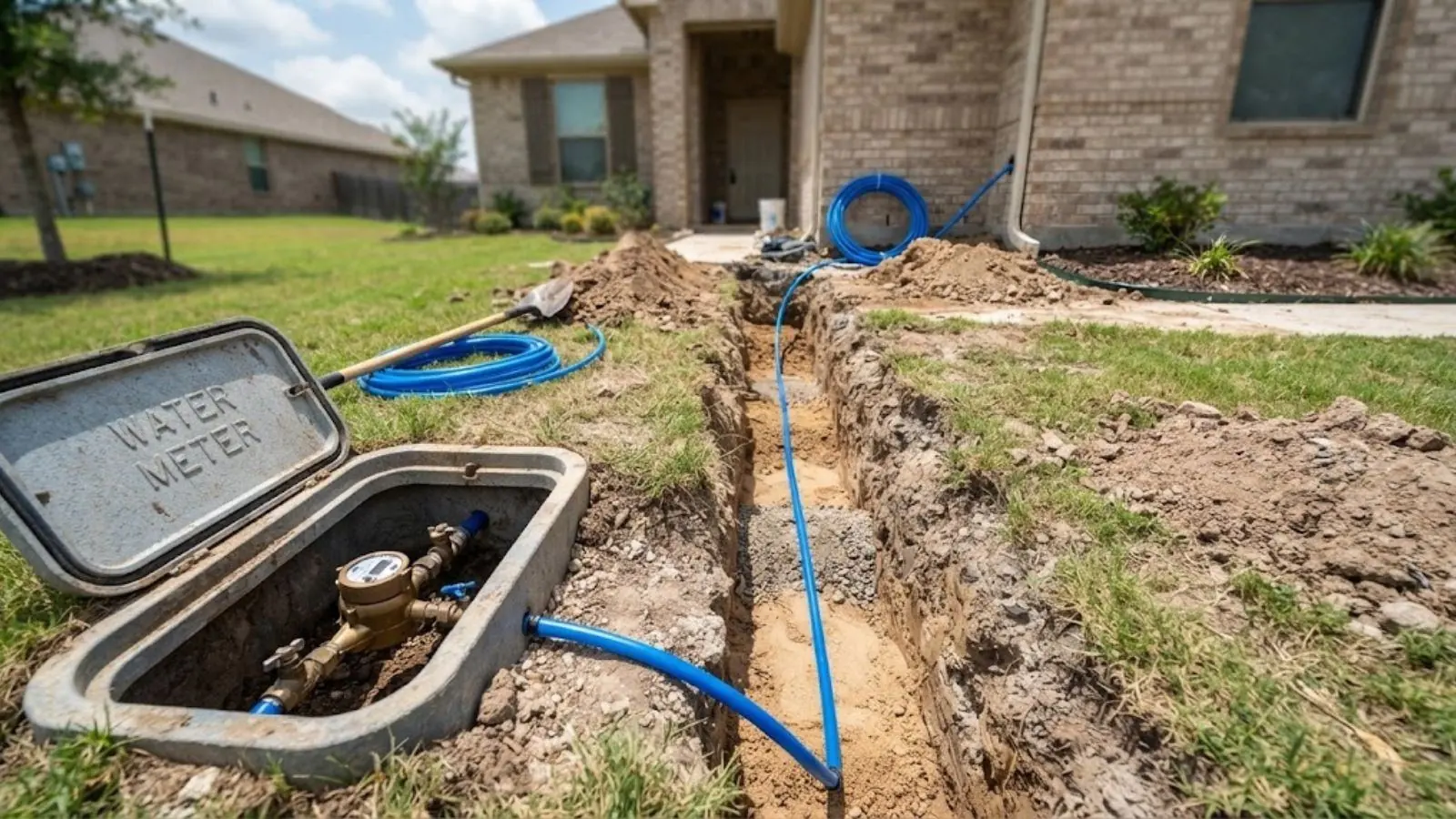
When a water line failure is an emergency
Call right away if water is surfacing in the yard, pooling along the foundation, or running with no pressure at all indoors. A split pipe inside the house is a different job, covered under burst pipe repair. A line that has broken under pressure can empty a lot of water into the ground without a sound. Slower signs, such as a lawn patch that stays green and soggy, can usually wait for a same-day appointment when available.
While you wait for us.
Close the main valve inside the house, then check whether the water in the yard slows or stops. If it keeps coming, the break is on the utility side of the meter, and that is something to report to your water supplier at once.
Note the meter reading, take a photo of the wet area, and keep kids and pets off soft ground near a driveway or slab. Do not dig. Call 811 first, because gas, power and communication lines also run through yards.
Who owns which part: Veolia, the City of Eagle or a private well
In Eagle, ID, water arrives from Veolia Water Idaho, from the City of Eagle's own system, or from a private well in some outlying areas. Which one serves you depends on the address, and your bill will tell you. Ask that utility where its responsibility ends, because we will not guess where the line of ownership falls.
That answer decides who digs. A break on the utility side of the meter is theirs to repair. A break between the meter and the house is generally a plumbing job we can quote. On a private well, the line from the pressure tank to the house is yours from end to end.
Close to home.
Star Sewer & Water District runs its own municipal water delivery in Star, and the City of Garden City provides water to its own residents. If your home is just west of Eagle, check which of these serves you before calling anyone about the line. Our crews cover Star and Garden City as well as Eagle.
How we confirm the line is leaking before we dig
We never start with a shovel. Digging a guess costs more than any test. First we confirm the leak is on the service line, then we narrow where.
- Shut off every fixture, note the meter reading, wait two hours with no water use, and read it again. The EPA says that if the meter moves, you probably have a leak.
- Close the home's main valve and watch the meter. If it still moves, the leak is between the meter and your valve. If it stops, the leak is inside the house.
- Put a pressure gauge on a hose bib to see whether pressure holds or sags.
- Use acoustic listening gear and a pipe locator along the path to find the hiss and the line's route.
- Mark the spot, call 811, and plan the repair.
Our leak detection page covers slab, wall and irrigation leaks that mimic a service line problem, and we rule those out first.
Low water pressure: a bad line or something simpler?
Weak pressure does not always mean a broken service line. Many causes sit inside the house and cost far less to fix. Use the table below to sort the symptom before you assume the worst.
| What you notice. | Likely cause. | First check. |
|---|---|---|
| Low pressure at every fixture. | Partly closed main valve or failing pressure regulator. | Open the main fully and read a gauge at a hose bib. |
| Low on hot only. | Water heater valve or sediment. | Compare hot and cold at one faucet. |
| One fixture weak. | Clogged aerator or cartridge. | Unscrew the aerator and look. |
| Pressure fell slowly over months. | Corroded galvanized line. | Look at pipe material at the main. |
| Sudden drop plus a wet yard. | Service line break. | Meter test and call us. |
If the whole neighborhood is weak, call your supplier, not a plumber. We only repair what is on your side in Eagle, ID.
Open trench or trenchless: what decides the method
A buried line can be replaced two ways. An open trench exposes the whole pipe and lets us check the bedding and fittings. Trenchless methods pull or push a new pipe through the old path with small pits at each end, which saves a driveway or a mature lawn and trees.
Trenchless is not always possible. Pipe condition, soil, depth, bends and other buried lines decide it, and we will say so after we see the route. Plain open-cut is often the right call for a short run where a trench is easy.
Water main, lead pipe and no-water questions
Replacing the water main in the street is the utility's work, not ours. If your neighbors lost water too, call the supplier. If only your house is dry, check the main valve, then call us.
Many homeowners ask whether their line is lead. We cannot tell from the street, and we will not claim anything about lines in Eagle. Ask your utility for any record of your service line material, and look at the pipe where it enters your house near the main valve.
What decides the cost of a water line repair
What shapes the price.
- Length and depth of the line. Longer, deeper runs mean more excavation, more pipe and more time, whether open-cut or trenchless.
- What sits on top of it. Lawn, concrete, pavers and plantings all change the work needed to open the ground and put it back.
- Pipe material and size. The new line must match your supply, and different pipe types have different fittings and costs.
- Spot repair or full replacement. One clean break can be a spot repair. A line with several failures often makes more sense replaced.
- Permits and utility coordination. Permits for this work run through DOPL, and what applies varies, so ask them. Work at the meter may need your utility.
Policies handle buried lines unevenly. Some treat the service line separately or exclude it as wear, so ask your insurer before work starts. We cannot promise coverage.
The route we find under the yard drives the figure. Call (208) 679-8357 for a clear price before work starts.
Why the Eagle Road and State Street corridors matter to your line
Homes along Eagle Road and State Street, and in neighborhoods like The Preserve, sit near a lot of buried utility in Eagle, ID and across Ada County. That raises the odds that a trench crosses another line, so an 811 locate is more than a formality. It also means the route we choose may differ from the shortest path.
Common questions
Do you handle water line repair emergencies at night or on weekends in Eagle?
Yes. A wet yard or a pressure drop at night gets the same dispatch as a daytime call, and (208) 679-8357 runs 24/7 through weekends. Same-day appointments are offered when available, with no promised arrival time. Close the main valve and stay on the line for guidance.
Why is my water pressure suddenly low?
Check the main valve, then a gauge at a hose bib, then the pressure regulator. A sudden drop with a wet yard points to the service line, and a meter test will confirm it.
How do I know if the leak is on my side of the meter?
Close your main valve and watch the meter. If it still moves, the leak is between the meter and your valve. Then ask your utility where its responsibility ends.
Who is my water supplier in Eagle, ID?
It may be Veolia Water Idaho, the City of Eagle or a private well. Your bill shows which, and they can tell you which part of the line they maintain.
Do you replace the water main in the street?
No. That belongs to the utility. We repair and replace the service line on your side, and we can help you describe a problem to the utility.
Do I need to call 811 before you dig?
Yes, always. A locate marks buried utilities before any digging starts and protects other lines. Call 811 even for a small hole.
If your yard is wet or the pressure has fallen, close the main and call (208) 679-8357.
Call (208) 679-8357Standards and sources
Plumbing work in Idaho follows the state plumbing code, which is based on the 2015 Uniform Plumbing Code (UPC) with state amendments in IDAPA 24.39.20. Permits and licenses come from the Idaho Division of Occupational and Professional Licenses (DOPL), not the city.
- U.S. EPA: Fix a Leak Week (federal agency)
- Idaho DOPL plumbing FAQs (state agency)