
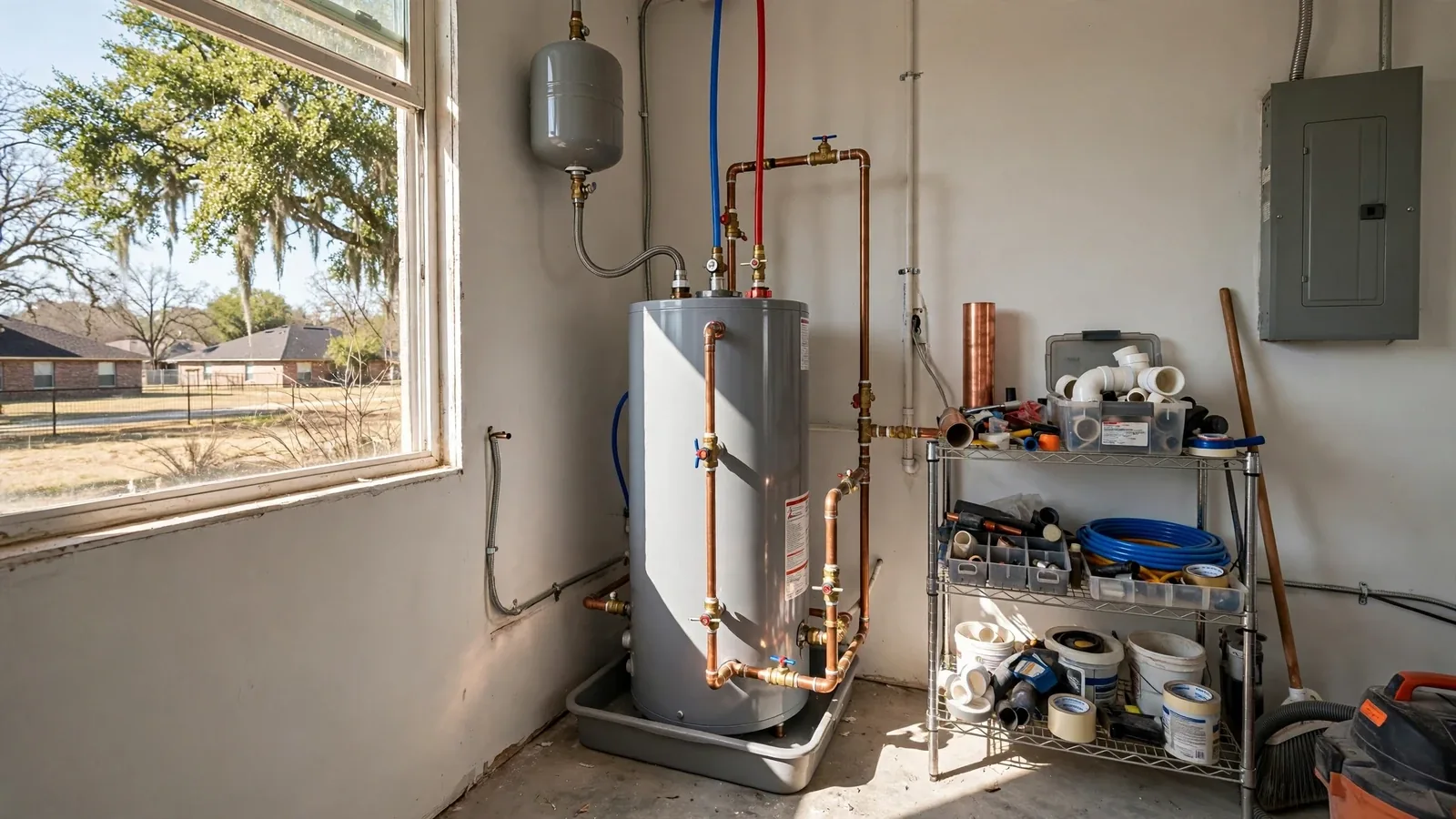
Sizing a new heater by first hour rating
The most common sizing mistake in Eagle, ID or anywhere is buying by tank gallons. The U.S. Department of Energy tells homeowners to total the hot water used in their peak hour and choose a storage heater whose first hour rating is at or above that total. First hour rating is how much hot water the tank can deliver in its first hour of use.
The DOE worked example uses a shower at 20 gallons, hand dishwashing at about 2 gallons per minute, a dishwasher at 7 gallons per use, a top-loading washer at 25 gallons and a front-loader at 15. Its sample household lands on a 66 gallon peak hour. Ours will look different, and we walk through your own busiest morning and match the number to the label.
Choosing between a tank, a tankless unit and a heat pump
The three types solve different problems. A storage tank is the simplest and the least expensive to install. A tankless unit saves floor space and heats on demand, and a heat pump model uses less energy but needs room and air.
| Type. | Typical life (DOE). | Install notes. |
|---|---|---|
| Storage tank. | 10 to 15 years. | Simple swap if venting and fuel stay the same. |
| Tankless. | About 20 years. | Output limited to about 2 to 5 gallons per minute, bigger gas line and vent often needed. |
| Heat pump (hybrid). | Varies by maker, check the manual. | Needs room, open air and a condensate drain. |
We cover the tankless side on our tankless water heater page. A heat pump unit is a real option in a basement or a large utility room, and we will tell you plainly if your house does not suit one.
Location, venting and the garage rule
Where a heater sits affects how long it lasts and how safe it is. A garage, a closet, a basement and a utility room each have their own limits for clearance, combustion air and drainage. We also look at where a leak would go, because a heater above finished space needs a drain pan and a path for water.
A garage is where a lot of Eagle, ID water heaters live, and a state amendment to the 2015 Uniform Plumbing Code speaks to it. The flame source must sit 18 inches or more off the floor, unless the unit carries a flammable vapor ignition resistant listing. We choose the stand or the model with that in mind.
Moving a vent route is a common part of an upgrade. Where the exhaust is Category 3 or 4, the state code calls for a full-system air test, five pounds held for fifteen minutes. We put that test on the schedule when your vent type requires it.
Expansion tanks, relief valves and the parts people forget
A quality installation includes more than the tank. These parts protect the heater and your house, and they are the first things skipped by a quote that looks low.
- A temperature and pressure relief valve with a discharge pipe that ends at a safe spot.
- An expansion tank on closed systems, so heated water has room to grow.
- Shutoff valves on the cold inlet and, where fitted, the fuel line.
- Flexible connectors or new unions in place of corroded old ones.
- A drain pan and drain line where a leak would damage finished space.
- A sediment trap on gas supply lines and a leak check at every joint.
Larger jobs, such as running new lines, relocating a heater or adding a recirculation loop, fall under plumbing installation work. We scope them together so the quote matches the day.
Permits and who pulls them in Idaho
Permits here are not a city matter. The state Division of Occupational and Professional Licenses (DOPL) issues them for Eagle, ID and the rest of Ada County, and a building permit from the city or county cannot stand in for one. A permit runs out a year (365 days) after you buy it or after its last inspection, and DOPL takes inspection requests by phone or online.
Who can move a heater a short distance.
Idaho's plumbing code lets a water heating appliance specialty journeyman disconnect, cap, remove and reinstall a water heater within 60 inches of its original location in one and two family homes. Anything farther, or any new vent or fuel line, falls under the wider permit rules, so ask DOPL.
Owners of their own primary or secondary home can pull a plumbing permit themselves, though not for a commercial building. Beyond that the rules depend on the job, so DOPL at 208-334-3233 is the place to ask. It can also confirm any plumber's licence before you hire.
New homes and fast growth in Star
Star's population grew 91.9 percent from 2010 to 2020, to 11,117 people. New construction along State Street and around Westpointe Park means many heaters are only a few years old. A newer heater rarely needs replacing, but a builder-grade unit may still be undersized for a growing household.
If you bought a new house, check the rating label against your peak hour before you add a soaking tub or a second shower. We serve Star and Eagle, and we can size an upgrade over the phone if you read us the label. If a leak does appear, see water heater replacement.
What the installation day looks like
Walk the site.
We confirm the location, clearances, venting, fuel and the shutoff valves before we touch anything.
Remove the old tank.
We shut down power or gas and water, drain the tank and disconnect it. We haul it away.
Set, connect and vent.
The new heater goes on a level base. We connect water, fuel or power, install the relief valve and discharge pipe, and set the vent.
Test and walk you through.
We fill the tank, purge air, check for leaks, test combustion or power, and show you the shutoff valves and thermostat.
Most swaps take a day, though a vent change or a new circuit can add time. A ready utility room and clear access make it shorter.
What moves the price of an installation
What shapes the price.
- Heater type and size. Storage, tankless and heat pump units sit in very different price ranges, and a larger tank costs more than a smaller one.
- Fuel and venting. Switching fuel, running a new vent or meeting the garage height rule adds parts and labor.
- Code and safety parts. Expansion tank, discharge pipe, shutoff valves and any required air test add to materials and time.
- Permit and inspection. A DOPL permit and inspection may apply, and scheduling adds a step.
- Access and haul-away. Tight spaces, stairs and the removal of the old tank affect labor.
A planned swap is not an insured event, because policies cover sudden accidental damage and not age. If the old heater already leaked and hurt the room, ask your agent about that damage separately.
Size, fuel, venting and the permit all feed the figure. Phone (208) 679-8357 and the clear price before work starts comes with your plan.
Common questions
How do I size a water heater for my family in Eagle?
Total the gallons you use in your busiest hour and pick a heater whose first hour rating is at or above it. The Department of Energy's method counts a shower as about 20 gallons and a dishwasher as 7.
Does water heater installation need a permit in Idaho?
The state issues the permit through DOPL, and the city does not. What your job needs depends on the work, so DOPL at 208-334-3233 can tell you.
Can I install my own water heater?
Idaho allows homeowners to buy a plumbing permit for work on their own primary or secondary residence. Gas and venting are safety-critical, and we advise against DIY on them.
Can you move my water heater or reroute the vent?
Often yes. A new location changes the water lines, fuel and vent, and a Category 3 or 4 vent needs the five-pound air test. We scope that before we start.
Should I switch to a heat pump water heater?
It is worth asking when the room allows it, because a heat pump unit needs space, air volume and a condensate drain. We look at the room and tell you if a storage tank is the better fit.
How long will my new heater last?
The Department of Energy says storage tanks last 10 to 15 years and tankless about 20. Flushing and checking the anode rod help.
To plan an install for your house, call (208) 679-8357 and have your current heater's label in hand.
Call (208) 679-8357Standards and sources
Plumbing work in Idaho follows the state plumbing code, which is based on the 2015 Uniform Plumbing Code (UPC) with state amendments in IDAPA 24.39.20. Permits and licenses come from the Idaho Division of Occupational and Professional Licenses (DOPL), not the city.
- U.S. DOE: Sizing a New Water Heater (federal agency)
- Idaho DOPL plumbing FAQs (state agency)
- IDAPA 24.39.20 Idaho State Plumbing Code (state agency)