
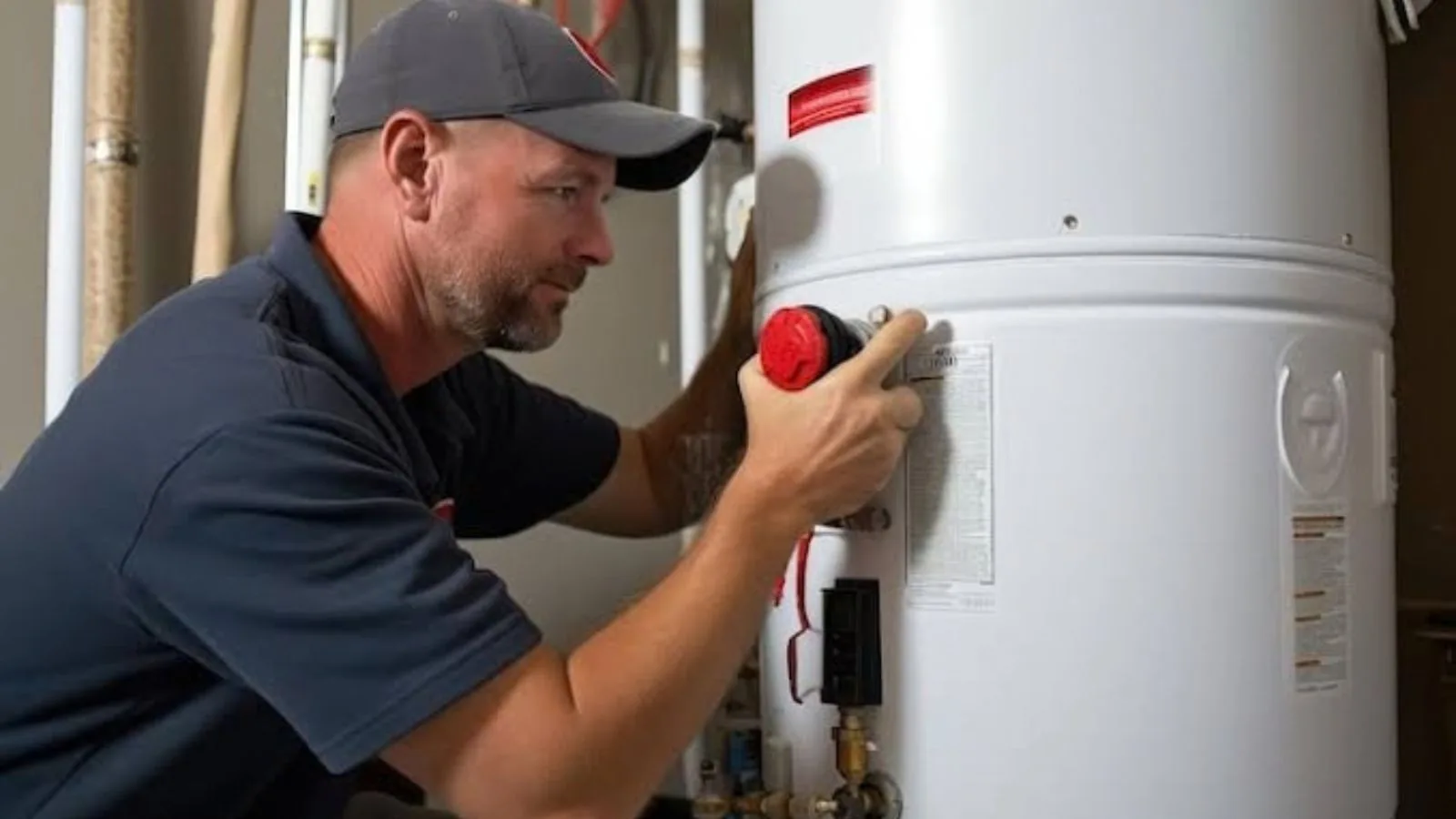
When a failed tank is an emergency
Some heater problems can wait for a morning appointment. Others cannot, because every hour of leaking soaks drywall, flooring and insulation. Water on the floor that keeps coming back after you wipe it up is the clearest sign that the tank itself has failed.
- Water pooling under or around the tank, not just a few drops at a pipe fitting.
- A rusty or brown stain running down the outside of the tank jacket.
- Hot water that runs out within minutes, or never gets warm at all.
- Rust-colored water from the hot taps only, while the cold taps run clear.
- Rumbling or popping from the tank, plus moisture at the base.
We take after-hours and weekend calls in Eagle, ID on the same 24/7 dispatch line. We offer same-day appointments when available, and we never promise an arrival time we cannot control. Tell the dispatcher what you see and what you have already shut off.
While you wait for us.
Turn off the power at the breaker for an electric heater, or turn the gas control to off on a gas unit. Close the cold water valve on the pipe above the tank by turning the handle until it stops.
Keep everyone away from standing water if it reaches outlets or a power strip. Do not touch the hot discharge pipe. Move boxes and rugs off the floor, and take a photo of the damage before you start cleaning.
A leaking water heater: tank, fitting or relief valve
Callers search for a water heater leak before they search for a replacement, and the source of the water decides everything. We trace it before we quote a new tank. Dry the floor, wipe the tank and pipes with a paper towel, then watch where the first bead of water returns.
A drip at the cold inlet, hot outlet or a union is a fitting problem. A leak from the pipe that runs down from the temperature and pressure relief valve points to a valve opening, which can come from excess pressure or heat. Water coming out from under the jacket, or from the drain valve area with a rusty trail, means the steel tank has corroded through.
A tank that has rusted through cannot be patched. The water you see is only part of it, because the inner liner has already failed. That is the situation where replacement is the only sound answer, and the one we confirm with a moisture meter and a close look at the bottom seam. Fitting and valve leaks often belong on our water heater repair side of the ledger instead.
Repair or replace: the decision rules we use
Here is how we weigh it, in plain terms. The U.S. Department of Energy says storage tank water heaters last 10 to 15 years. Age sets the starting point, and the failed part sets the rest.
| What failed. | Heater age. | Usual call. |
|---|---|---|
| Tank body leaking or rusted through. | Any age. | Replace. |
| Heating element or thermostat. | Under about 8 years. | Repair. |
| Heating element or thermostat. | 10 years or more. | Weigh repair against replacement. |
| Relief valve, drain valve or fitting leak. | Any age, tank sound. | Repair. |
| Gas control or burner failure. | 10 years or more. | Often replace. |
| Sediment rumble with a sound tank. | Under 10 years. | Flush and repair. |
The table is a starting point and not a rule. A newer heater with a bad thermostat is a repair. An old one with two bad parts in a year is a replacement, because the next part is likely close behind.
Rust-colored water and no hot water at all
Brown water from the hot taps only usually means the tank or its anode rod is giving up. Brown water from both hot and cold points to the pipes or the supply instead, which is a different job. We run each tap for a minute and compare before we blame the heater.
No hot water at all can be a tripped breaker, a pilot that went out, or a dead element, and none of those need a new tank. We check power or gas first, then test the elements or thermocouple. If the cause is a worn-out tank, we say so and explain why, and you decide.
Age-checking late-2000s heaters in The Shores and Two Rivers
Homes in The Shores were built from 2006 to 2019, and custom homes in Two Rivers from roughly 2000 to 2017. A heater installed with the house in 2007 or 2008 is now at or past the 10 to 15 year range the Department of Energy gives for storage tanks. If your home is from that era and the original heater is still there, treat it as a unit living on borrowed time.
Find the serial number on the rating label. Most manufacturers encode the build date in it, and the manual or the maker's website explains how to read it. Knowing the age before the tank fails lets you plan a calm daytime swap instead of a flooded utility room in Eagle, ID. Call us at (208) 679-8357 with the label details and we will tell you what we see.
Garage heaters and the 18-inch rule.
The state plumbing code, built on the 2015 Uniform Plumbing Code with amendments, keeps the flame in a residential garage at least 18 inches off the floor, unless the heater has a flammable vapor ignition resistant listing. Plenty of homes in Ada County keep the heater in the garage, so we check this when we plan the swap.
Sizing the new tank before we set it
A tank that is too small runs out in the middle of the second shower. The Department of Energy method is simple: total the gallons your household uses in its busiest hour, then choose a unit rated to cover that number in its first hour.
Its worked example counts a shower at 20 gallons, hand dishwashing at about 2 gallons per minute, a dishwasher at 7 gallons per use, a top-loading washer at 25 gallons and a front-loader at 15. That example comes to a 66 gallon peak hour. We run your own morning through the same list and match the rating on the label. The same sizing math applies in Eagle, ID and in newer builds in Star.
What the swap looks like on the day
Shut down and drain.
We shut off power or gas, close the water, and drain the old tank to a floor drain or the yard. We check the old connections before disconnecting them.
Set and connect.
The new tank goes on a level base. We make up water lines, add the right relief valve and discharge pipe, and connect power or gas with a leak check on every joint.
Vent, fill and test.
We confirm the vent draws properly, fill the tank, purge air at a tap and run the heater through a full cycle. We haul the old tank away.
Permits matter in Eagle, ID too. The state Division of Occupational and Professional Licenses (DOPL) issues them and the city does not. Call DOPL at 208-334-3233 to learn what applies to your job. For a planned job instead of a failure, see water heater installation.
What moves the price of a replacement
What shapes the price.
- Tank type and capacity. A larger tank, a power-vent unit or a high-efficiency model costs more than a basic atmospheric unit. Capacity should follow your peak-hour number, not the size of the old one.
- Fuel and what you already have. Swapping like for like is simpler than changing from gas to electric, which can mean a new circuit or removing a gas line and flue.
- Venting and location. A new vent route, a garage that needs the 18-inch rule met, or a tight closet adds labor. Easy access to a utility room keeps the visit short.
- Code and safety parts. Expansion tank, relief valve discharge pipe, shutoff valves and a drain pan add materials. Idaho's code also calls for an air test on certain vent types.
- Permit and time of the call. A DOPL permit and inspection may apply to the job. After-hours work can be priced differently from a daytime appointment, and we tell you which before we start.
When a tank bursts overnight, insurers usually look at the water damage, not the heater. Slow leaks, wear and the failed unit tend to be excluded. Read your policy or call your agent before repairs begin, and keep photos and the old tank's label.
Capacity, fuel type and the state of the old install set the price. Dial (208) 679-8357 for a clear price before work starts.
Common questions
Do you handle water heater replacement emergencies at night or on weekends in Eagle?
Yes. A tank that gives out overnight is one of our most common after-hours calls, and (208) 679-8357 is open 24/7. Same-day appointments are offered when available, but no arrival time is promised. Tell the dispatcher what is leaking and what you have shut off.
Why is my water heater leaking from the bottom?
Water at the base can come from the drain valve, a failing fitting or the tank itself. If a rusty trail runs from under the jacket, the tank has corroded through and replacement is the answer.
My heater is 12 years old and still works. Should I replace it now?
The Department of Energy puts storage tank life at 10 to 15 years, so you are in the range where failure becomes likely. Planning a daytime swap costs less in damage risk than waiting for a flood.
Can a heater in the garage stay where it is?
Often yes, but the state code wants the burner and ignition source in a residential garage at least 18 inches above the floor, unless the heater is flammable vapor ignition resistant. We check this on every garage job in Eagle.
Can you swap my gas water heater for an electric one?
It can be done. It often means a dedicated circuit and capping the gas line and flue, so the job is bigger than a like-for-like swap. We explain the steps before you decide.
Do you replace a heater that flooded?
Yes. Heaters with wet controls or burners usually need replacing after standing water reaches them. We also check the area for hidden moisture before we say the job is done.
Can I switch to a heat pump water heater?
Sometimes. The room decides it, since a heat pump unit needs space around it, a large air volume and a spot for condensate to drain. Tell us about your utility room when you call and we will talk it through.
If your tank is leaking or your hot water is gone, call the 24/7 line and we will walk through the next step with you.
Call (208) 679-8357Standards and sources
Plumbing work in Idaho follows the state plumbing code, which is based on the 2015 Uniform Plumbing Code (UPC) with state amendments in IDAPA 24.39.20. Permits and licenses come from the Idaho Division of Occupational and Professional Licenses (DOPL), not the city.
- U.S. Department of Energy guide to sizing a water heater (federal agency)
- Idaho State Plumbing Code (IDAPA 24.39.20) (state agency)
- Idaho DOPL plumbing FAQs (state agency)