
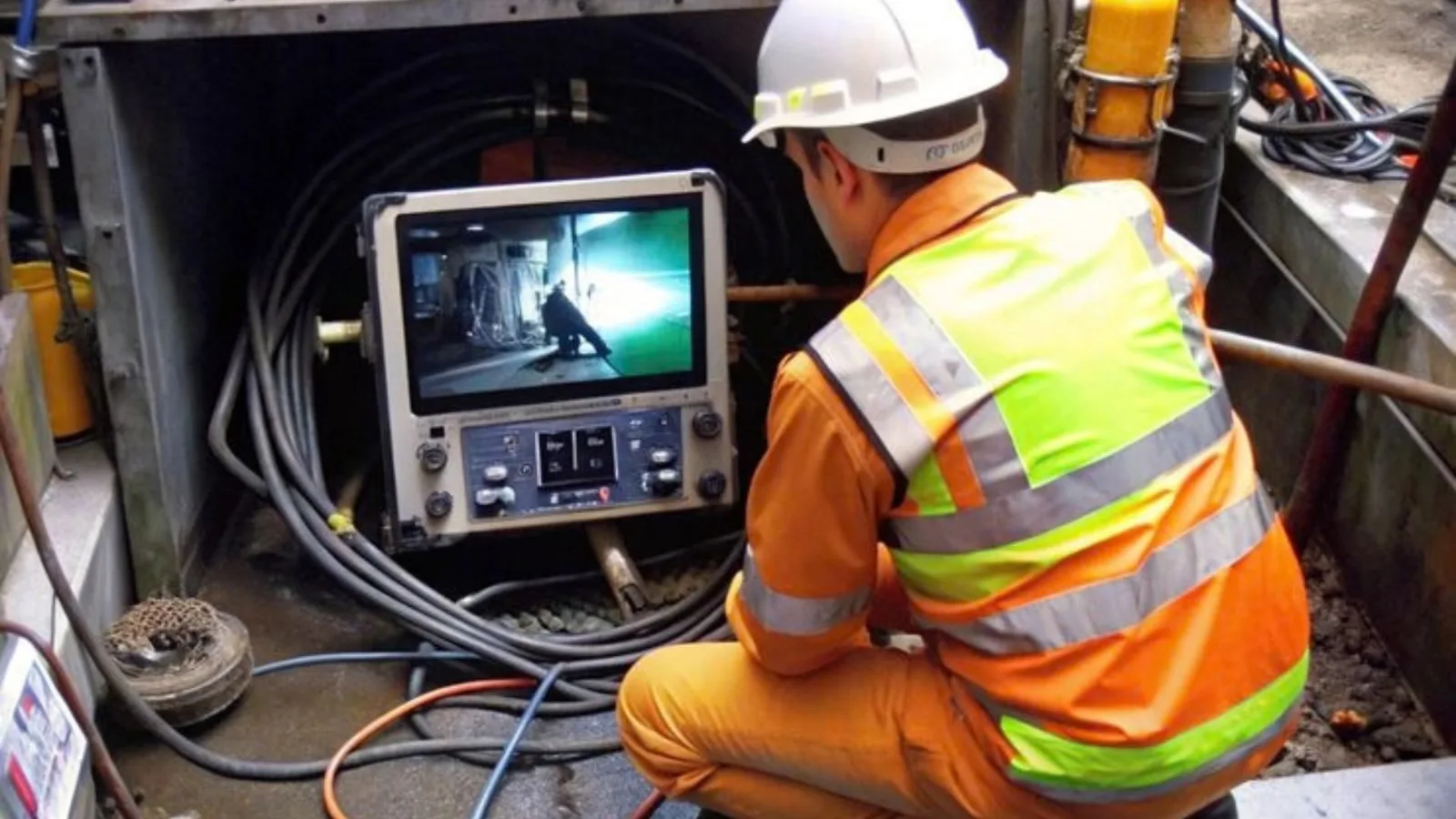
What a sewer camera shows you
A small waterproof camera head on a flexible push cable goes in through the cleanout and travels down the line. A light on the head and a monitor let us watch the pipe wall as it passes. A transmitter in the head lets a locator find the head from above ground, so we can mark where a problem sits and how deep it is.
- Cracks, broken sections and offset joints.
- Roots entering at joints.
- Sags, called bellies, where water and waste pool.
- Scale, grease and debris buildup.
- Pipe material, such as plastic, clay or cast iron.
- Connections from other lines, such as a second bathroom group.
Local fact.
The Eagle Sewer District provides sewer service in Eagle, ID, and the public main is its pipe. Our camera covers the private lateral on your lot, and we will tell you if the footage shows trouble in the street main.
We describe what we see in plain words and point to it on the screen. If you are buying, you can ask the plumber to walk the pipe with your agent on the line.
What the camera cannot tell you
A camera is a visual tool, and it has limits. It cannot see through a full blockage, so we may need to clear the line first. It does not pressure test the pipe, and it cannot see the public main unless the head reaches it from your cleanout.
A camera also does not replace a home inspector's report on the rest of the house. If you have a septic system instead of a sewer connection, tank condition is a separate trade. We do not guess at what we cannot see, and we will say when the footage is incomplete.
Buying in Star or Eagle: scope the line before closing
Star grew from a small town to 11,117 people in 2020, with the population up 91.9 percent from 2010 to 2020. A fast-growing market means buyers often have a short window to inspect. Ask early about a sewer scope, because a repair found after closing is yours.
For homes in Star, see our Star plumber page, and for any home we can scope the lateral from a cleanout. If the seller cannot find the cleanout, we can often pull a toilet to get access. A scope also gives you a basis to ask for a repair credit before you commit.
Banbury Meadows and The Preserve: two build eras, two sets of questions
Banbury Meadows went up in phases from 1994 to 2019 around Banbury Golf Course. The Preserve, near Linder Road and State Street, has homes built about 2013 to 2018. We do not know what pipe is under any one lot until the camera runs, but era does shape what we look for.
In older phases, we watch for joint wear and root entry. In newer ones, we look for sags from settled backfill and leftover construction debris. Either way, a baseline recording now lets you compare it with a later scope.
When to schedule a sewer inspection
Different situations call for the camera for different reasons. This table lists the common ones and what we look for.
| Situation. | What we check. | What you get. |
|---|---|---|
| Buying a home. | Cracks, roots, sags, pipe material. | A picture of the lateral before you close. |
| Repeat clogs after cleaning. | Whether a defect keeps catching waste. | A cause, not another cleaning. |
| Before landscaping or a pool. | Pipe path and depth. | A marked route so no one digs on top of it. |
| After a backup. | Whether the pipe is damaged. | A repair or cleaning plan. |
| Slow drains in many fixtures. | Main line condition. | Clear direction on cleaning or repair. |
Call 811 before any digging, even after we mark the line. That call covers public utilities, and our locator marks the sewer only.
What happens during a visit
Find the access.
We locate the cleanout, or pull a toilet if there is none.
Run the camera.
We push the camera through the line and watch the monitor as it travels.
Mark problems.
If we find a defect, we use the locator to mark its position and depth above ground.
Explain what we saw.
We go over the findings with you and, when repairs are needed, outline the options.
If the footage shows buildup, hydro jetting may be enough, and a crack points toward sewer line repair. Older homes in Garden City, where housing mostly dates from the postwar years to the 1980s, are a common reason for a scope. We work there as well, and there too we never guess at pipe from the home's age.
What drives the price of a sewer inspection
What shapes the price.
- Access to the line. A usable cleanout speeds the job. If we must pull a toilet, it takes more time.
- Length of pipe to scan. A short lateral takes less time than a long run to the street.
- Cleaning before the scan. A blocked or heavily coated pipe may need clearing first, which adds a step.
- Locating and marking. Marking the route and depth with a locator adds time but gives you a map of the pipe.
- Written findings. If you need a summary of the findings for a lender or an agent, tell us when you call.
A camera inspection is a planned cost, not an insured loss. If the camera finds a defect, ask your agent how your policy treats that kind of damage before you file anything, since wear and gradual leaks are commonly excluded.
Access and pipe length drive the price of a camera run. Contact us at (208) 679-8357 and hear a clear price before work starts.
Common questions
Should I get a sewer inspection when buying a home in Eagle, ID?
It is a smart step, because the lateral is buried and a home inspector cannot see it. A camera shows cracks, roots and sags before you close. Ask early, since inspection windows are short.
Does a sewer camera inspection find where the pipe runs?
Yes. A transmitter in the camera head lets a locator mark the pipe path and depth on the ground. That helps you avoid it when digging or landscaping.
Can you do a camera inspection of a p-trap or a single fixture drain?
Sometimes. A small camera can pass some p-traps and short branch lines, but tight bends can stop it. We will tell you if a fixture drain is too tight to scope.
Which sewer district serves my home, and who maintains the main?
The Eagle Sewer District provides sewer service in Eagle, ID, but districts differ by address. Check which one serves yours and ask where its responsibility ends. The private lateral on your lot is the part we scope.
Do landlords and property managers schedule inspections too?
Yes. Send the address and cleanout details when you call, and tell us if a tenant needs to be home.
What if the camera cannot get through the line?
A full blockage or collapsed section can stop it. We then clear what we can, mark where the camera stopped and explain the options.
Planning a purchase or a dig and want the pipe checked first? Call our licensed plumbers and tell us the address.
Call (208) 679-8357Standards and sources
Plumbing work in Idaho follows the state plumbing code, which is based on the 2015 Uniform Plumbing Code (UPC) with state amendments in IDAPA 24.39.20. Permits and licenses come from the Idaho Division of Occupational and Professional Licenses (DOPL), not the city.
- Idaho DOPL plumbing FAQs (state agency)