
Flow rate and temperature rise set the size
A tankless unit is rated by how many gallons per minute it can heat by a certain number of degrees. Two numbers decide whether it works for you. Flow is how much hot water runs at once. Temperature rise is how many degrees the unit must add between the cold supply entering the house and your set point.
The DOE puts the ceiling for tankless hot water at roughly 2 to 5 gallons per minute. That sounds like plenty until two showers and a dishwasher start together. Winter makes it harder, because colder incoming water means the heater must add more degrees to the same flow. A unit that covers July can fall short in January.
We size by walking the house. We count the fixtures that can run at the same time, note the longest pipe runs, and check the cold water temperature at a tap on a winter morning. Then we match that load to the unit's rated output at your temperature rise, not the number printed for mild water.
Tankless or storage tank: a plain comparison
This table shows how the two designs differ on the points that matter most to a homeowner. The life figures and the output limit come from the U.S. Department of Energy.
| Point. | Tankless. | Storage tank. |
|---|---|---|
| Typical life (DOE). | About 20 years. | 10 to 15 years. |
| Hot water output. | Limited to about 2 to 5 gallons per minute. | Set by the first hour rating. |
| Standby heat. | None, heats on demand. | Keeps a full tank hot all day. |
| Gas line and vent. | Often needs a larger gas line and special venting. | Usually reuses the old connections. |
| Upkeep. | Periodic descaling flush. | Sediment flush and anode rod check. |
| Space. | Wall mounted, small footprint. | Floor standing, larger footprint. |
If your household rarely runs more than two hot taps at once, a single tankless unit works well. If three or four run together most mornings, a storage tank or two tankless units may fit better. We will tell you which, even when the answer is a smaller job.
Gas line capacity, electric load and venting
Most gas tankless units burn far more fuel per hour than a tank heater, so the gas line has to carry it. Intermountain Gas Company supplies natural gas in Eagle, ID. We check the pipe size, the run length and the other appliances on the line before we pick a unit. A line that served a tank heater fine can starve a tankless unit and cause weak heat or fault codes.
Venting is the second check. Condensing units use plastic vent pipe and need a drain for the acidic condensate. Idaho's plumbing code, built on the 2015 Uniform Plumbing Code, wants a heater with Category 3 or 4 exhaust venting pressure tested as a whole, five pounds of air for fifteen minutes (section 503.1).
Garage installs have a height rule: burner and ignition source at least 18 inches up from the floor, unless the unit has a flammable vapor ignition resistant listing (507.13). That rule decides where a unit can hang. Electric tankless units skip the gas and the vent, but they draw heavy amperage, and your panel and wiring need room for it. We do not size electrical service, so that part is a job for a licensed electrician.
If you smell gas.
Get everyone out right away, including pets, and call Intermountain Gas Company's 24-hour line at 800-548-3679 from outside. Call 911 as well. Do not use switches, plugs or a phone inside the building, and call a plumber only after the utility says the home is safe.
Flushing and descaling a tankless water heater
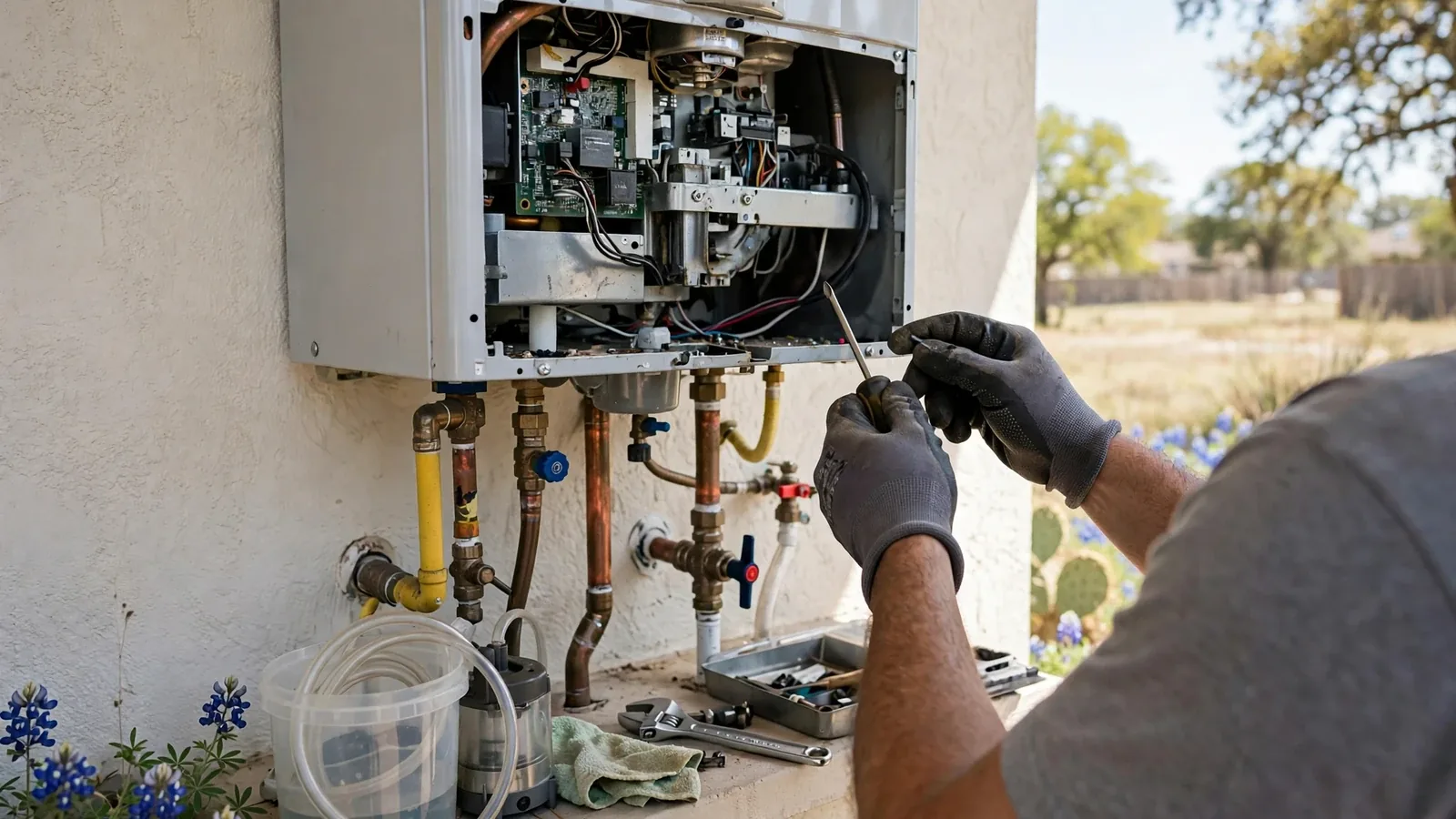
Minerals in the water collect inside the heat exchanger and slow the transfer of heat. A scaled unit runs hotter, cycles on and off, and may throw a fault code. A flush dissolves the scale and carries it out through a hose.
Most units have two isolation valves and two service ports on the water lines. We use those ports to circulate a descaling solution through the heat exchanger. The maker's manual names the solution and the time, because the wrong acid can harm internal parts.
- Shut off the gas or power to the unit and close the hot and cold isolation valves.
- Connect hoses and a small pump to the service ports.
- Circulate the descaler the manual allows for the time it calls for.
- Rinse with clean water and clean the inlet screen.
- Open the valves, restore gas or power, and test hot water at a tap.
Flush timing depends on your water and the manufacturer's instructions, so check the manual instead of trusting a rule of thumb. In Eagle, ID, the supply may be Veolia Water Idaho, the City's own system or a private well, depending on the address. We do not know your hardness without a test. Your supplier's yearly water quality report or a tap test answers it, and our page on water softener and filtration options helps if scale is heavy.
Custom homes in Two Rivers and The Shores need a load count
Custom homes in Two Rivers (built roughly 2000 to 2017) and The Shores (2006 to 2019) were designed one at a time, so no two floor plans match. We count your fixtures and your simultaneous use instead of assuming a standard house. Sometimes the answer is two units, or one unit plus a recirculation line for a far bathroom.
Some original storage heaters from the late 2000s have reached the Department of Energy's 10 to 15 year range. That is often when owners start asking about a swap. If your heater is near that age, a tankless unit rated for about 20 years deserves a fair look next to a new tank.
Banbury Meadows homes went up in phases from 1994 to 2019, so heater age and gas line layout vary from house to house. A look at the existing gas pipe and vent path tells us quickly whether a swap is simple. For new builds in Star, where the population rose 91.9 percent from 2010 to 2020, we can size the unit during rough-in, and our Star service page covers that area.
What a tankless water heater does not fix
The phrase endless hot water is a little generous. The unit keeps heating as long as demand stays under its rated flow, and it slows down when demand passes that line. Know the limits before you buy.
- It does not raise water pressure. Low pressure is a supply or pipe problem, covered under water line work.
- It does not remove the wait at a far tap. A long pipe still holds cold water until the hot arrives.
- It can give a short burst of cold between two close uses, because the unit needs a moment to fire again.
- It does not soften water. Scale still builds, so plan on flushes.
If you want to compare designs side by side, our water heater installation page explains sizing for storage tanks too.
What moves a tankless water heater quote
What shapes the price.
- Unit size and type. A larger output or a condensing model changes the price of the unit and the vent it needs. Sizing comes first, so we do not sell more heater than your load needs.
- Gas line or electrical upgrades. A bigger gas pipe takes more labor and material than reusing the old one. Electric models may need panel work from an electrician, which is separate from our plumbing.
- Vent path and material. A short, straight run through an outside wall is simple. A long run, a roof exit or a garage location adds parts and time, and the Category 3 or 4 air test adds a step.
- Valves, flush ports and recirculation. Isolation valves and service ports make future flushes easy, and a recirculation line shortens the wait at far taps. Both add parts and labor.
- Permit and removal of the old heater. The permit comes from the state Division of Occupational and Professional Licenses and not the city. Hauling off the old tank and any needed inspection also count.
A tankless upgrade is a choice, not a loss, so insurance is unlikely to help with it. Coverage applies when an old heater bursts and floods a room, and it generally skips wear and slow leaks. Ask your agent before you file.
Gas line size and the vent path matter as much as the unit itself. Call (208) 679-8357 and hear a clear price before work starts.
Common questions
How do I know what size tankless water heater my Eagle home needs?
Add up the fixtures that can run together, then compare that flow to the unit's rating at your winter temperature rise. The Department of Energy puts tankless output at about 2 to 5 gallons per minute, so a large household may need more than one unit.
How often should a tankless water heater be flushed?
It depends on your water and the maker's instructions, so follow the manual. If you see fault codes, longer waits for heat or noise from the unit, scale may be the cause, and a flush is the first step.
Is the water hard in Eagle, and does it matter for a tankless unit?
We do not state a hardness number because it varies by supplier and address. Supply comes from Veolia, from the city's own system or from a well, depending on where you live. The supplier's yearly water quality report is the place to look, and a tap test fills the gaps.
Do I need a permit to install a tankless water heater in Eagle, ID?
Yes, in many cases. The state issues plumbing permits through DOPL (the city does not), and a building permit from the city or county does not replace one. Homeowners may buy a permit for their own residence, and since rules vary by job, DOPL at 208-334-3233 has the answer for yours.
How long does a tankless water heater last?
The Department of Energy says tankless units last about 20 years, against 10 to 15 years for storage tanks. Regular flushing is what protects that number.
Will a tankless water heater give me unlimited hot water?
No. It heats continuously, but only up to its rated flow. Past that, the water cools or the flow drops, which is why sizing matters so much.
Ready to size a tankless unit for your own fixtures and gas line? Call our licensed plumbers and we will walk through the numbers.
Call (208) 679-8357Standards and sources
Plumbing work in Idaho follows the state plumbing code, which is based on the 2015 Uniform Plumbing Code (UPC) with state amendments in IDAPA 24.39.20. Permits and licenses come from the Idaho Division of Occupational and Professional Licenses (DOPL), not the city.
- U.S. DOE: Which Water Heater Is Right for You (federal agency)
- Idaho DOPL plumbing FAQs (state agency)