
Emergency leak detection when the meter will not stop
Most hidden leaks announce themselves on paper before they show up on a floor. The water bill jumps, the meter moves with the house quiet, or the pressure at the tap drops. The U.S. EPA says the average household leaks more than 9,300 gallons a year, and about 9 percent of homes leak 50 gallons or more per day.
The EPA meter test is simple. Write down the meter reading, use no water for two hours, then read it again. If the number moved, you probably have a leak. A faucet dripping once per second wastes more than 3,000 gallons a year by itself, so rule out the obvious ones first.
- A meter dial or low-flow triangle that moves with every fixture off.
- A water bill well above your usual months.
- Pressure that drops at the tap without a clear reason.
- A damp, green or soft patch in the yard, or a wet spot on the garage slab edge.
We take these calls day and night on our 24/7 dispatch line in Eagle, ID, including weekend and overnight calls when a leak is actively running. We offer same-day appointments when available and do not promise an arrival time.
While you wait for us.
Shut the main water valve at the house and look at the meter. If it stops, the leak is inside the house or on your side of the meter. If it keeps moving, the leak is likely on the line before the valve.
Do not cut into a wall or dig on a guess. If you see water pooling in the yard, mark the spot with a flag, keep people and pets off soft ground, and tell the dispatcher.
Slab leaks: a warm floor and the sound of running water
A hot spot on a floor, a hissing sound from under the slab or a damp patch at the edge of the garage slab can all mean a pressurized line is leaking underneath concrete. Hot water lines are the usual suspects when the floor feels warm. Carpet that stays wet near a wall and baseboards that lift are other clues.
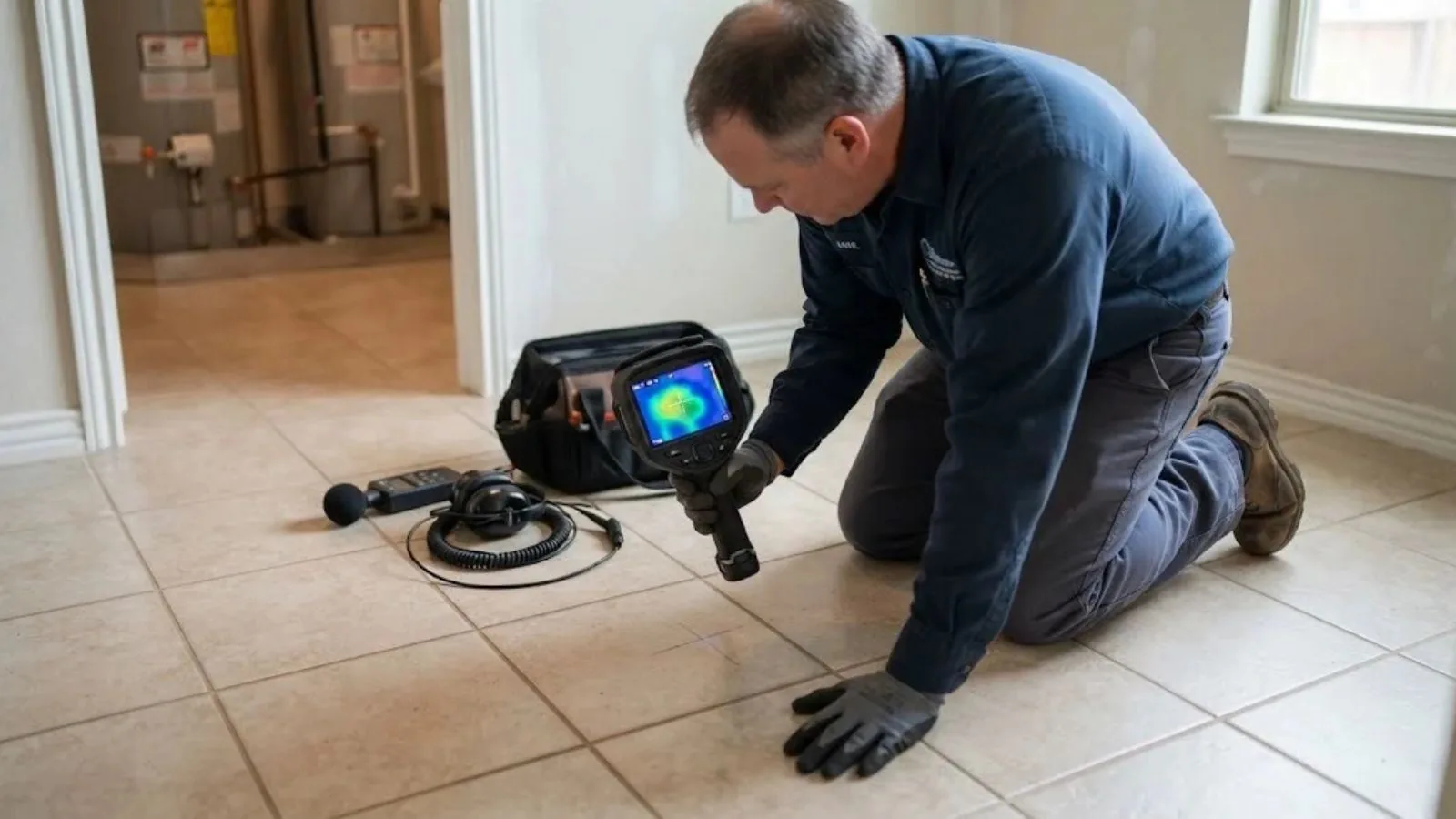
We start with a pressure test on the hot and cold lines to learn which one is losing water. Then we listen with acoustic equipment and trace the path with a pipe locator. A thermal camera shows warm lines under the floor, and a moisture meter confirms the wet zone before anyone drills.
Finding a slab leak is not the same as fixing it. Options include opening the slab over the leak, rerouting the line through the walls or ceiling, or repiping the section. We lay out the trade-offs, and a repiping plan sometimes beats repeated slab openings.
Water service line leaks between the meter and the house
The service line is the pipe that carries water from the utility's meter to your house. A leak there can run for months without showing up inside. Signs include a soft, green or constantly wet strip of yard, low pressure and a meter that moves when the main is shut.
We confirm the leak is on the service line with a meter test, then listen along the pipe path and use a locator to trace it. Across Ada County, we do not guess at who owns what. Ask your water utility where its responsibility ends and where yours begins. For a confirmed line break, see water line repair.
A wet ceiling or stained wall
A brown ring on a ceiling or a bubbled patch on a wall tells you water is present, but not where it started. Water travels along framing and pipes before it shows. A stain in the dining room may start in the bathroom above.
We scan the area with a moisture meter and a thermal camera to map the wet zone, then check supply lines, drain lines, shower pans and appliance hookups above it. We also run a pressure test to see whether a supply line is leaking or the water comes from a drain, roof or window.
Roof leaks and condensation are not plumbing, and we say so when that is what we find. If a drain line is dripping above the ceiling, we explain the repair and the drywall work that comes after it. Anywhere in Eagle, ID, turn off the water to the room above if it is still wet, and call us at (208) 679-8357.
Leaks under the house or in a crawlspace
Not every home has a crawlspace, but those that do give a plumber a direct look at the pipes. Older supply lines can corrode at joints and hangers, and a drain line can sag and drip at a coupling. Sagging insulation, musty smells and damp soil are the clues.
We check each exposed run with a flashlight, a moisture meter and a mirror, and we listen with the main shut and then open. If water is dripping, we trace it to a fitting, a split pipe or a failed valve. We avoid crawling into spaces that are unsafe, and we tell you if the space needs to be dried or cleared first.
Finding a buried line without digging up the yard
Underground pipe is hard to read from the surface. A wet spot may sit twenty feet from the actual leak, because water follows soil and gravel. We use several tools, and each answers a different question.
| Tool. | What it tells us. | Limit. |
|---|---|---|
| Pressure test. | Whether a line holds pressure. | Does not say where the leak is. |
| Acoustic listening equipment. | Where leak noise is strongest. | Weaker on quiet, plastic or very deep lines. |
| Tracer gas. | Gas rising through soil or slab at the leak. | Needs the line isolated and filled. |
| Thermal imaging. | Warm or cool paths from leaks. | Works best on hot lines and indoor surfaces. |
| Moisture meter. | Wet drywall, wood or slab. | Shows wet material, not the source. |
| Pipe locator. | Path and depth of a buried pipe. | Needs a line it can trace. |
Call 811 before anyone digs for any reason. The free utility locate marks buried lines so a shovel does not hit them. We pair the locate with our own tracing and then mark a spot small enough to open.
Pressurized irrigation and sprinkler leaks
The Shores, Two Rivers and Banbury Meadows have pressurized irrigation, which means a second network of pipe runs through the yard next to the home's drinking water line. A broken sprinkler head or a cracked irrigation lateral can run all night. In the growing season it can look just like a service line leak on the bill.
The tie-back is the meter. If your water bill jumped in summer, find out which meter the irrigation water comes through, and ask your supplier how that water is billed. We tell the two networks apart by isolating each and pressure testing it. If the leak is in the irrigation system, we say so and you can decide whether a sprinkler specialist is the better call.
Commercial buildings, pools and the meter box
Commercial leak detection uses the same tools on bigger systems. We take small commercial calls such as shops, offices and restaurants, and we are honest that large buildings with complex systems need a specialist. See commercial plumbing for the kind of work we do.
If your home has a pool or spa, a leak is hard to separate from evaporation, so a bucket test and a pressure test on the plumbing lines are the first steps. Pool shell leaks are a pool company's job. In the front yard, a meter box that fills with water often points to a leak at the meter or a failed valve, and that belongs to your water utility.
Homes beside the Laguna Pointe lake or near the Boise River in Eagle, ID can have surface water in a yard that has nothing to do with plumbing. The meter test tells you the difference. A meter that stays still means the water is not coming from your pipes.
After we find it: repair, the utility and permits
Detection finds the leak. Repair may be a separate step, and it may need a permit or a utility. Idaho plumbing permits come from the state Division of Occupational and Professional Licenses (DOPL), not the city, and permit rules vary, so ask DOPL at 208-334-3233 if you are unsure.
Some fixes are quick, such as replacing a supply line or a valve. Others mean trenching, opening a floor or working with your water utility. We write down the leak location, the test results and the repair options so you can compare them. A burst or split pipe may call for burst pipe repair, and older plumbing anywhere, including postwar houses in Garden City, can fall in that category.
What drives the price of finding a leak
What shapes the price.
- How many tools the leak needs. A visible drip is a quick fix. A leak that needs a pressure test, listening gear and a locator takes more time and equipment.
- Depth and surface. A line under a slab or a deep yard run is harder to read than an exposed pipe in a crawlspace.
- Size of the property. A small house with one meter is quick to isolate. A large house, several zones or an irrigation network adds steps.
- Access. Finished walls, tile floors and landscaping slow the work and can limit where we can test.
- Repair after detection. Opening a slab, trenching a service line or repiping a section is a separate scope with its own materials and labor.
Leak claims often stall on one question: was it sudden or gradual. Many policies cover sudden water damage and exclude slow leaks, wear and the cost of locating the break, so call your agent before you open a wall. Keep your meter readings and our written report for the file.
Reach depends on how hard the leak is to get at. Call (208) 679-8357 for a clear price before work starts on any detection visit.
Common questions
Do you handle leak detection emergencies at night or on weekends in Eagle?
Yes. A meter that spins after midnight is a reason to call, and (208) 679-8357 takes those calls 24/7, weekends too. We offer same-day appointments when available but never promise an arrival time. Close the main valve and tell the dispatcher what the meter does.
My water bill jumped. How do I know if I have a leak?
Run the EPA meter test. Note the meter reading, use no water for two hours, and read it again. The EPA also says a family of four using over 12,000 gallons a month in winter may have serious leaks.
How do you find a leak without digging up the yard?
We pressure test the line, then use acoustic listening gear, tracer gas and a pipe locator to narrow the spot. Call 811 before any digging.
Will the leak be repaired at the same visit?
Sometimes, if it is a simple fitting or valve. Slab, buried and utility-side leaks usually need a separate repair plan, and some need a permit or your water utility.
Who supplies water to my home in Eagle?
It depends on the address. Water in Eagle comes from Veolia Water Idaho, from the City of Eagle's own system or from private wells in some outlying areas. Ask your supplier for your account details.
Can you check a sprinkler or irrigation line for leaks?
We can test the pipe and pressurized irrigation lines in The Shores, Two Rivers and Banbury Meadows, and we say clearly when the leak is in the sprinkler system and not the house plumbing.
I manage rental properties. Can you handle leak calls for several units?
Yes. Landlords and property managers call us regularly. Give the address and unit and tell us what the meter or tenant is reporting.
If your meter will not stop or a wall is wet, call the 24/7 line and tell us what you have found so far.
Call (208) 679-8357Standards and sources
Plumbing work in Idaho follows the state plumbing code, which is based on the 2015 Uniform Plumbing Code (UPC) with state amendments in IDAPA 24.39.20. Permits and licenses come from the Idaho Division of Occupational and Professional Licenses (DOPL), not the city.
- U.S. EPA: Fix a Leak Week (federal agency)
- Idaho DOPL plumbing FAQs (state agency)