
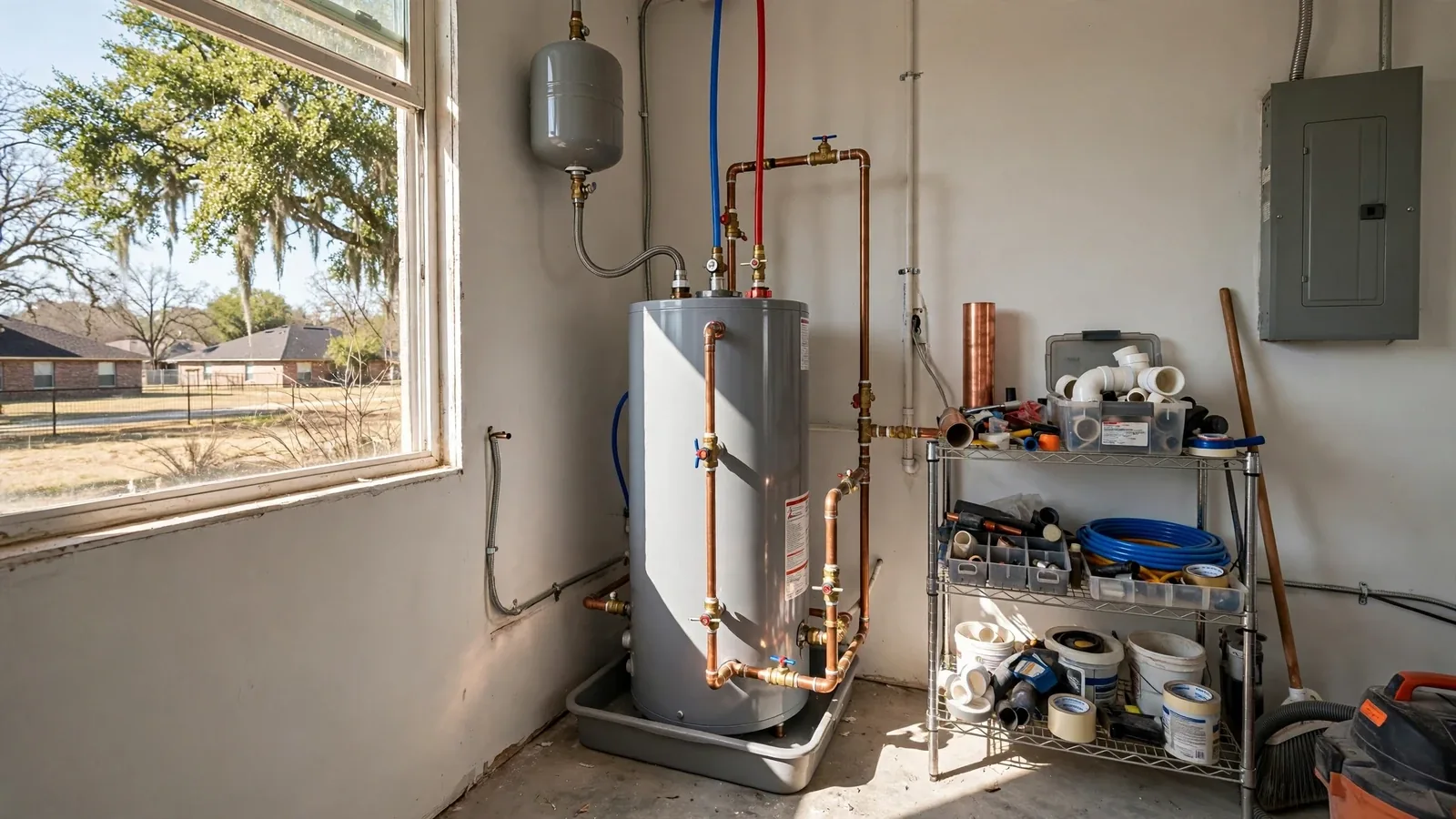
What the labor on a water heater swap actually covers
Labor is the time and skill that turn a boxed heater into a working, safe one. It starts when the plumber shuts off the water and the fuel, and it ends only after the heater has been tested under pressure and heat.
- Shutting off and draining the old tank, then disconnecting water, gas or electric and the vent.
- Hauling away the old heater, which is heavy and awkward on stairs.
- Setting the new tank level on a stand, pan or platform where the job calls for one.
- Making up new water connections, shutoff valves and a flexible or rigid supply.
- Connecting gas or electric, including a new line or breaker when needed.
- Installing the vent and checking that exhaust leaves the house.
- Fitting the temperature and pressure relief valve and its discharge pipe.
- Adding an expansion tank where the water system calls for one.
- Filling, bleeding air, firing it up and testing for leaks.
Each item takes time, and the time rises when the layout is cramped or old parts fight back. A swap in the same spot, with good valves and a clean vent, is the quick version of the job.
Five reasons two quotes for the same heater differ
Scope.
One quote may include the permit, the vent work and the haul-away. Another may list only the tank and a basic hookup.
Condition of what is already there.
Corroded shutoffs, a failing vent or a gas line that is too small add work the plumber cannot see from the phone.
Fuel and type.
A gas tank, an electric tank and a tankless unit each need different connections, and so labor differs.
Location.
An attic, a tight closet or a garage platform changes the time and the safety steps involved.
Code items.
Relief valve piping, expansion control and venting tests take real time and are required for a reason.
How to compare two quotes line by line
Ask each plumber for the same line items. If the answers come back in different shapes, you are comparing unlike things. Use this table as a checklist when you call.
| Line item. | What it covers. | Ask this. |
|---|---|---|
| Heater. | Make, capacity, fuel, efficiency. | Is the size matched to my household? |
| Venting. | New pipe, new termination or reuse. | Is the old vent being reused, and is it safe? |
| Hookups. | Water, gas or electric, shutoffs. | Are new shutoff valves included? |
| Safety parts. | Relief valve and discharge pipe, expansion tank. | Is each one listed? |
| Permit. | State permit and inspection. | Who pulls it, and is it in the price? |
| Haul-away. | Removal of the old tank. | Is disposal included? |
The goal is a clear price before work starts. If a quote cannot say what is in and what is out, ask again before you sign.
Venting, relief piping and expansion: the parts people skip
These three items add labor, and they are the first ones a rushed install leaves out. A vent that does not draw properly can send exhaust into the house. A relief valve with no discharge pipe can scald someone when it opens. An expansion tank takes up the extra volume that heated water creates in a closed system.
None of the three shows up as a feature of the heater. They show up as hours on the job. When one quote is far lighter than the others, check whether these are the difference.
Same spot or new spot: how relocation changes the work
Moving a heater means new water lines, a new vent route and sometimes a new gas or electric run. That can double the labor of a plain swap, and it can bring in other trades. If you are thinking of a move, say so on the first call.
Our page on water heater installation covers sizing and location in more detail. If your tank has already failed, water heater replacement explains what the first day looks like.
Red flags in a labor quote
- A price given before anyone asks about fuel, size or location.
- No mention of a permit on a job that normally needs one.
- A relief valve or vent left off the written scope.
- Pressure to sign today.
- A refusal to name the plumber's DOPL license when you ask.
Anyone can check a plumber's license with DOPL. A licensed and insured plumber will expect the question.
What insurance does and does not cover
Homeowners policies usually respond to sudden accidental damage, such as a tank that bursts and floods a room. They often exclude gradual leaks, wear and the failed heater itself. A new heater to replace a worn-out one is generally your cost, so read your policy and ask your agent before you assume.
Idaho permit and code items that add labor in Eagle, ID
For Eagle, ID and the rest of Ada County, DOPL issues plumbing permits and the city does not, and a building permit from the city or county is no substitute. Inspections go through DOPL too. An owner can buy a permit for work on their own residence, and each permit lapses 365 days after purchase or the last inspection, whichever came later.
Underneath sits the 2015 Uniform Plumbing Code with Idaho's amendments (IDAPA 24.39.20). One amendment requires a full-system air test for any water heater with Category 3 or 4 exhaust venting: five pounds of air held for fifteen minutes (section 503.1). That test takes real time on site, so it belongs in the labor line.
Another amendment affects garages. The burner and ignition source must clear the floor by 18 inches, unless the heater carries a flammable vapor ignition resistant listing (section 507.13).
If your heater sits in a garage, as it may in a home in The Shores or Two Rivers in Eagle, ID, that rule can mean a platform or a different model, and it adds labor. Our plumbers also work in Star and Garden City, where the same state code applies.
Common questions
What does water heater installation labor include?
Shutting off and draining the old tank, disconnecting it, hauling it away, setting and connecting the new one, venting, safety parts, testing and the permit when one is needed. Ask each plumber for the scope in writing.
Why is one plumber's labor quote so much higher than another's?
Usually the scope differs. One may include the vent, the permit and the haul-away, and another may not. Compare the quotes line by line before you decide.
Does a gas water heater cost more to install than an electric one?
Gas adds venting and a gas connection, and electric may need a heavier circuit. Which one takes more labor depends on what your house already has.
Does labor change if I move the heater to a new spot?
Yes. New water lines, a new vent route and sometimes a new fuel or electric run add hours. A swap in the same spot is the simplest version of the job.
Do water heater installs in Eagle, ID need a permit?
The permit is a DOPL matter. An owner may buy one for their own residence and ask DOPL at 208-334-3233 for the inspection. What your job needs depends on the work.
Can I ask for the price before work starts?
Yes, and you should. A clear price before work starts is what to expect, and you can call the dispatcher at (208) 679-8357 to get one.
To get a price built from your own heater, location and vent, call the dispatcher at (208) 679-8357.
Call (208) 679-8357Standards and sources
Plumbing work in Idaho follows the state plumbing code, which is based on the 2015 Uniform Plumbing Code (UPC) with state amendments in IDAPA 24.39.20. Permits and licenses come from the Idaho Division of Occupational and Professional Licenses (DOPL), not the city.
- Idaho DOPL plumbing FAQs (state agency)
- IDAPA 24.39.20 Idaho State Plumbing Code (state rule)
- U.S. DOE: Sizing a New Water Heater (federal agency)