
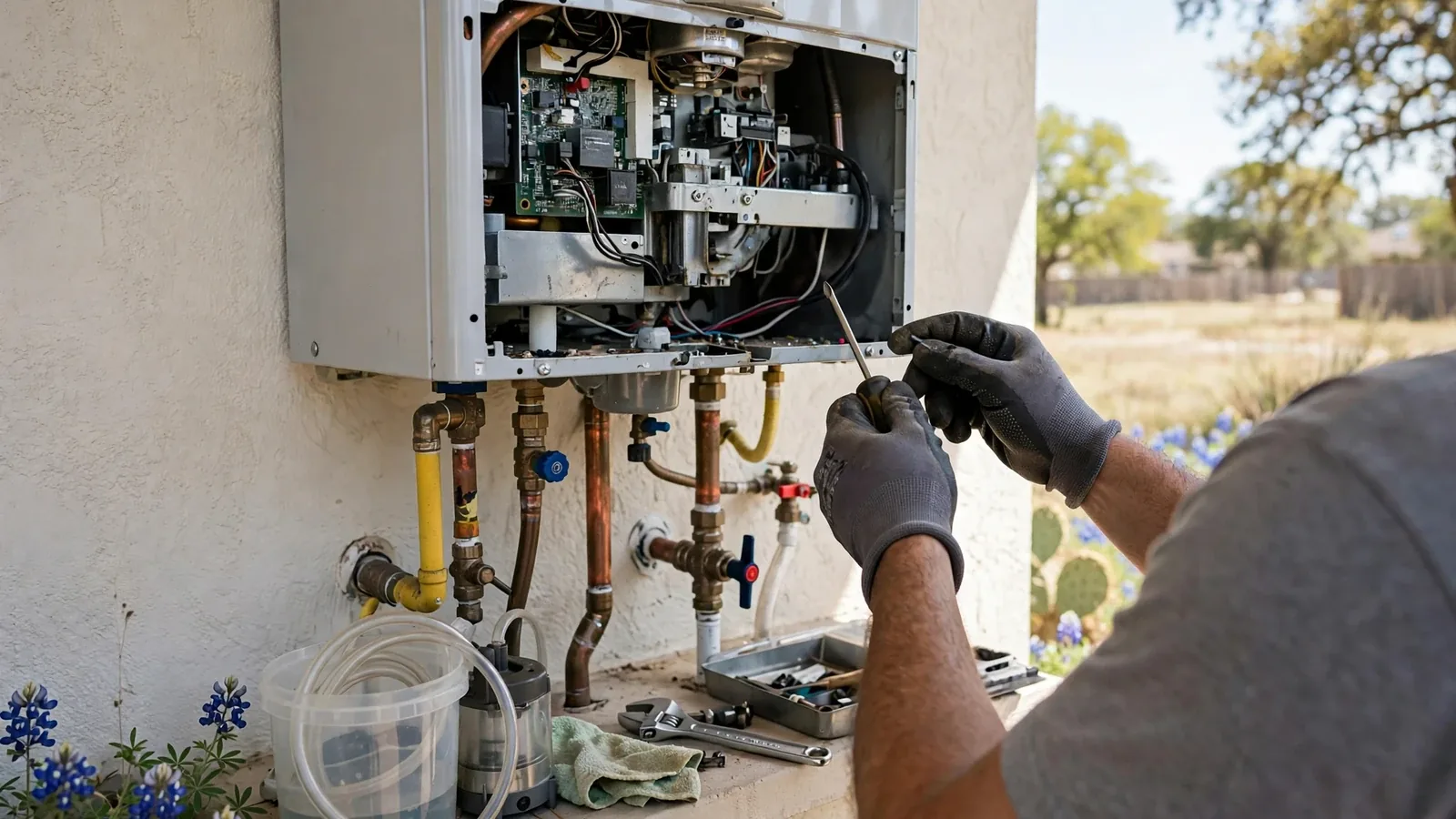
Flow rate and temperature rise: the two numbers that decide everything
Flow rate is how much hot water you want at once, measured in gallons per minute. Temperature rise is the gap between the cold water coming in and the hot water you want out. A heater that makes a 50 degree rise at 5 gallons per minute may only make a 70 degree rise at 3.
That is why a single number on the box means little. Every tankless maker publishes a chart of flow against rise. You read the chart at your needed rise and see how many gallons per minute you actually get.
Think of it like a garden hose through a heater. Push more water through, and each gallon spends less time being warmed. The Department of Energy's 2 to 5 gallons per minute ceiling is the practical limit of the whole class.
A sizing worksheet you can fill in at the kitchen table
You do not need special tools. You need a pencil and the model numbers of your fixtures.
- List every fixture that could run at the same time, such as two showers and a kitchen faucet.
- Find each fixture's flow rating. It is often stamped on the showerhead or faucet, or listed in the maker's data.
- Add the flows for the worst realistic moment in your day. That total is your peak gallons per minute.
- Decide the hot water temperature you want at the tap, then subtract the cold inlet temperature to get your rise.
- Compare your peak flow and rise against the maker's chart for each model you are considering.
Do not size for the weekday morning only. Size for the busiest realistic hour, such as guests in town, because that is the day the heater gets judged.
Simultaneous use: how your habits change the answer
Two people showering and a dishwasher running is a different load than one person showering. The table below shows how common habits push on the heater and what to do about it.
| Habit. | What it asks of the heater. | Sizing move. |
|---|---|---|
| One shower at a time. | Low peak flow. | A mid-size unit often fits. |
| Two showers at once. | Peak flow doubles. | Larger unit or two units. |
| Shower plus dishwasher or washer. | Mixed high and sustained draws. | Add the flows, then check the chart. |
| Long soaking tub fill. | High flow for several minutes. | Check the unit's cap at your rise. |
| Guests every weekend. | Peak load repeats. | Size for the guest day. |
If the numbers do not fit in one unit, there are three ways out. Stagger the use, install two units, or consider a storage tank heater installation that can cover short bursts better.
Why winter water makes tankless sizing harder
Incoming water is colder in winter, so the temperature rise you need is bigger. A bigger rise means the same heater delivers fewer gallons per minute. A unit that feels generous in September may run short in January.
We do not give an Eagle, ID winter inlet temperature here, because it varies with how deep your line sits and how long the water has been in it. A plumber can measure your incoming temperature on a cold morning. Size from that reading, not from a guess.
Gas input, gas line size and venting
A gas tankless heater burns a lot of fuel in a short time. Its input is rated in thousands of Btu per hour, and the house gas line, the meter and the regulator must all be able to deliver it. The pipe that fed a small tank heater is often too small for a big tankless unit.
Venting is the other limit. Tankless heaters use sealed or power-vented exhaust, and the vent type, length and number of bends all matter. A plumber checks the run against the maker's instructions before choosing the model.
- Read the unit's input rating and compare it to the line size and meter capacity.
- Confirm the vent type and the longest allowed run.
- Find a clear route for the vent and the condensate drain.
- Plan for service space around the unit, so valves and filters are reachable.
Electric tankless units and the electrical panel
Electric tankless heaters need heavy current. In general terms, a unit sized for a whole house can draw far more amperage than a typical tank heater, and it may need its own heavy circuit or even a panel upgrade. Check the amperage on the data plate against your panel before you commit to a model.
Small point-of-use electric units are a different case. They serve a single sink or shower and draw less. They are not a whole-house answer, but they can cover a faraway bathroom.
When one unit is not enough
Two tankless units can be linked to share the load. A tankless heater paired with a small storage tank is another layout. Both cost more to install than a single unit, so they make sense only when your peak flow truly calls for them.
Start from the real peak load, then pick the layout. Our page on tankless water heater service covers the options a plumber walks through.
Gas and water supply for tankless units in Eagle, ID
Natural gas in Eagle is supplied by Intermountain Gas Company. Whether your gas line and meter can feed a tankless unit depends on the pipe size in your house and on what the meter delivers. Banbury Meadows was built in phases from 1994 to 2019, and The Preserve went up about 2013 to 2018. Homes from different decades may have different gas piping, so measure your own line instead of assuming.
Water in Eagle comes from Veolia Water Idaho groundwater wells, from the City of Eagle's own system or from private wells in outlying areas. The supplier depends on your address. We do not know your water hardness, and we will not guess. Request the utility's yearly water quality report or run a test on your tap, because scale is what slowly chokes a tankless heat exchanger.
Eagle, ID sits in Ada County, and homes in Star and Garden City get their water from different suppliers, so the same question applies there. A tankless unit lasts about 20 years per the Department of Energy, and the water you feed it decides whether it gets there.
Common questions
What size tankless water heater do I need for a family of four?
It depends on how many fixtures run together and on your winter inlet temperature, not on family size alone. Add the flow of the fixtures you use at once, find the rise you need, and compare that to the maker's chart.
Why does my tankless heater run out of hot water when two showers run?
The unit hit its flow limit at your temperature rise. The Department of Energy puts tankless output at about 2 to 5 gallons per minute, and two showers can exceed what one unit gives in winter.
Does an electric tankless heater need a new electrical panel?
Often it needs a heavy dedicated circuit, and sometimes the panel itself must be upgraded. Check the unit's amperage against your panel before you buy.
Can I use my existing gas line for a tankless water heater?
Only if it can carry the unit's input rating. A plumber checks the pipe size and the meter capacity first. If the line is too small, it must be upsized.
What should I ask my water utility in Eagle, ID before buying a tankless heater?
Ask for its yearly water quality report, since scale affects a tankless heat exchanger. Which supplier serves you, whether Veolia, the city or a private well, depends on your address.
Do I have to descale a tankless water heater?
Many makers call for periodic descaling, and the interval depends on the model and your water. Follow the manual that came with your unit.
If your fixture list is ready and you want it checked against a heater, call the dispatcher at (208) 679-8357.
Call (208) 679-8357Standards and sources
Plumbing work in Idaho follows the state plumbing code, which is based on the 2015 Uniform Plumbing Code (UPC) with state amendments in IDAPA 24.39.20. Permits and licenses come from the Idaho Division of Occupational and Professional Licenses (DOPL), not the city.
- DOE Energy Saver: choosing a water heater (federal agency)
- Intermountain Gas Company: emergency information (gas utility)
- Veolia Water Idaho 2024 annual report (Idaho PUC) (state agency)