
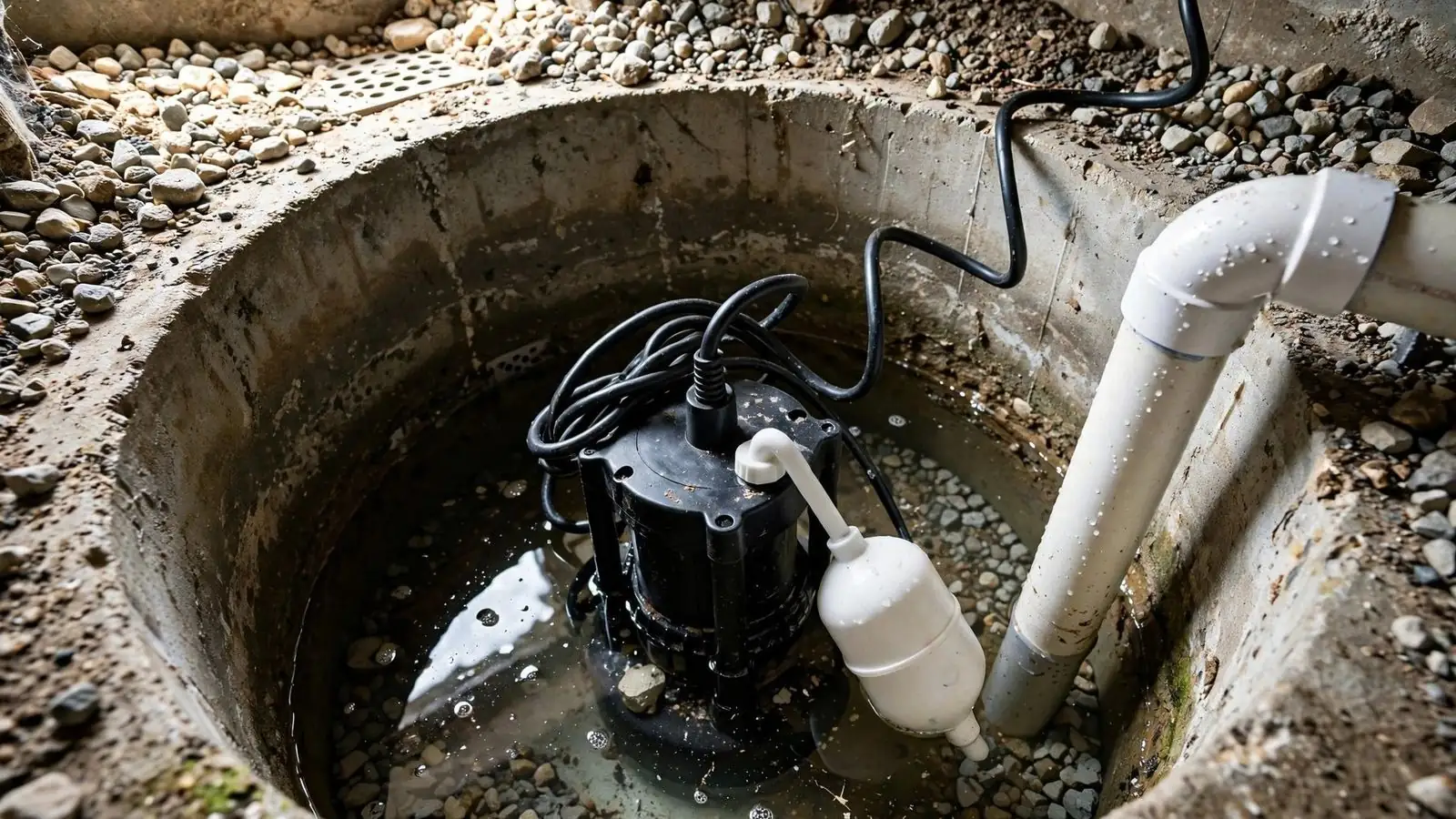
The bucket test, step by step
The test takes about ten minutes and needs only a bucket and a flashlight. Do it on a dry day, not in the middle of a storm, so you can take your time.
Look at the pit.
Lift the lid and shine a light inside. Remove any gravel, mud or debris from the bottom, since junk can jam the float or clog the pump intake.
Check the power.
Make sure the pump is plugged in and the outlet is live. Many outlets have a GFCI that trips and stays tripped, which leaves the pump dead without anyone noticing.
Pour in water.
Slowly add water from a bucket until the float rises. The pump should kick on, drop the water level, and shut itself off.
Watch the discharge.
Look at the outlet pipe outside, and listen for water moving. It should flow freely, and it should end well away from the foundation.
Listen for trouble.
A grinding, rattling or humming noise without pumping means a worn motor or a stuck impeller. A pump that cycles on and off every few seconds points to a check valve or float problem.
What each part does and how it fails
The float switch
The float rises with the water and tells the pump to start. Floats stick against the pit wall, get tangled in their own cord, or wear out, and a stuck float is the most common reason a good pump does nothing.
The check valve
The check valve sits on the discharge pipe and stops water from running back into the pit after the pump shuts off. When it fails, the pump short-cycles because the same water keeps falling back. You may hear a heavy thud or a slap after each cycle.
The discharge line
This pipe carries water out of the house. It can clog, kink, come loose at a joint, or end too close to the foundation so the water simply returns. A discharge that empties onto a neighbor's property or into a place you are not allowed to drain is a separate problem that needs sorting out.
Symptoms, likely causes and what to try
Use this table as a first pass before you call. It lists what homeowners notice and where the trouble usually sits.
| What you notice. | Likely cause. | Safe first check. |
|---|---|---|
| Pump does not start. | Tripped GFCI, stuck float, dead motor. | Reset the outlet, free the float by hand. |
| Pump runs but water level does not drop. | Clogged intake, failed impeller, blocked discharge. | Clean the pit and check the outlet pipe. |
| Pump cycles every few seconds. | Failed check valve, bad float placement. | Listen for backflow after each cycle. |
| Pump runs constantly. | Stuck float, very high inflow, undersized pump. | Check the float, then note how fast the pit refills. |
| Loud grinding noise. | Worn bearings, debris in the impeller. | Switch it off and call a plumber. |
Battery backup: what it covers and what it does not
A battery backup pump runs when the power is out, which is often exactly when heavy weather hits. It is a second pump with its own battery and a charger, and it needs the same testing as the main one.
The battery has a limited run time, and it does not help if the main failure is a clogged discharge line. Check the charger light, test the backup by unplugging the main pump, and replace the battery on the maker's schedule. If you are adding a backup to a pit that has none, that is a plumbing installation job, and the pit size matters for fitting two pumps.
An annual routine you can finish in one morning
- Run the bucket test and note how long the pump takes to clear the pit.
- Clean debris out of the pit and wipe the float.
- Check the discharge line outside for clogs, kinks and a clear outlet.
- Confirm the check valve holds water in the pipe after shutoff.
- Test the battery backup if you have one.
- Write the date on the pump with a marker so you know when you last tested.
That list is the whole job for most households. If anything on it fails, a plumber can tell you whether it is a ten-minute fix or a pump that has reached the end of its life.
Sump pump or sewage ejector: two pits that look alike
A sump pit collects groundwater and drainage from around the foundation. A sewage ejector pit collects wastewater from a basement bathroom or laundry, and it has a sealed lid and a vent. Do not open an ejector pit casually, since it holds sewage and gas.
If you are not sure which one you have, look for a sealed lid with a vent pipe. A sealed pit is an ejector, and a pump failing there is a wastewater problem that calls for a plumber right away.
Repair or replace the pump
A new float switch or check valve is a small repair on a pump that is otherwise sound. A pump that has run for years, shows rust, grinds, or has tripped its breaker more than once is a poor candidate for another repair.
The cost of any job comes from the pump type, the pit condition, how hard the discharge line is to reach, and whether a battery backup is included. You get a clear price before any pump job in Eagle, ID begins. If your pump is failing now, our sump pump repair page explains what we do on a visit.
New homes in Star and older ones in Garden City
Between 2010 and 2020 Star grew by 91.9 percent, so many houses there are new, and a new house may or may not have a pit. Check your builder paperwork or look in the lowest part of the house before you assume. If you want to know what we do around Star, that page has the details.
Much of Garden City's housing was built between the postwar years and the 1980s, and the Greenbelt winds past Plantation Island and the Glenwood Street bridge there. We cannot say what your groundwater does without seeing the site, so the pump you have should be tested the same way as anywhere else. Our page for a plumber in Garden City covers that area.
Boise River flooding history and your sump pump in Eagle, ID
Boise River flooding keeps showing up in Eagle's history, and the dams that followed Arrowrock in 1915 did not end it. Eagle Island, settled in 1863, sits in that same river valley. That history is a reminder that a sump pump belongs on a yearly maintenance list in Ada County, not a once-in-a-decade one.
We do not have verified data on groundwater depth at any address in Eagle, so we will not guess. The practical rule is simple. Test the pump before the wet season and again after any big storm, and look at the discharge line each time.
Many Eagle homes do not have a basement or a pit at all, and a homeowner with a slab foundation may never need a sump pump. If you are unsure, look for a round lid in the floor of the lowest room or utility area.
Common questions
How often should I test my sump pump?
Twice a year is a reasonable habit, and once more after any big storm. Use the bucket test and watch the discharge line.
My sump pump runs but the pit stays full. What now?
The discharge line may be blocked, the check valve may be stuck, or the impeller may be damaged. Switch the pump off if you hear grinding, and call a plumber.
Can I put a battery backup on any pump?
Not every pit has room for two pumps. A plumber checks the pit size, the discharge pipe, and the outlet before adding one.
Do homes in Eagle, ID usually have sump pumps?
Many Eagle homes have no basement and no pit, so look for a round lid in the floor of the lowest room before you assume. Recurring Boise River flooding is part of Eagle's history, so a home that does have a pit should keep its pump tested.
Is a sump pump the same as a sewage ejector?
No. A sump pump moves groundwater, and an ejector moves wastewater from a basement bathroom. An ejector pit has a sealed lid and a vent.
Does homeowners insurance cover a failed sump pump?
Policies differ. Many cover sudden accidental damage and exclude wear and gradual seepage, and some require an added endorsement for water backup. Read your policy or ask your agent.
If the bucket test went wrong, call (208) 679-8357 and describe what the pump did.
Call (208) 679-8357Standards and sources
Plumbing work in Idaho follows the state plumbing code, which is based on the 2015 Uniform Plumbing Code (UPC) with state amendments in IDAPA 24.39.20. Permits and licenses come from the Idaho Division of Occupational and Professional Licenses (DOPL), not the city.
- Idaho DOPL plumbing FAQs (state agency)