
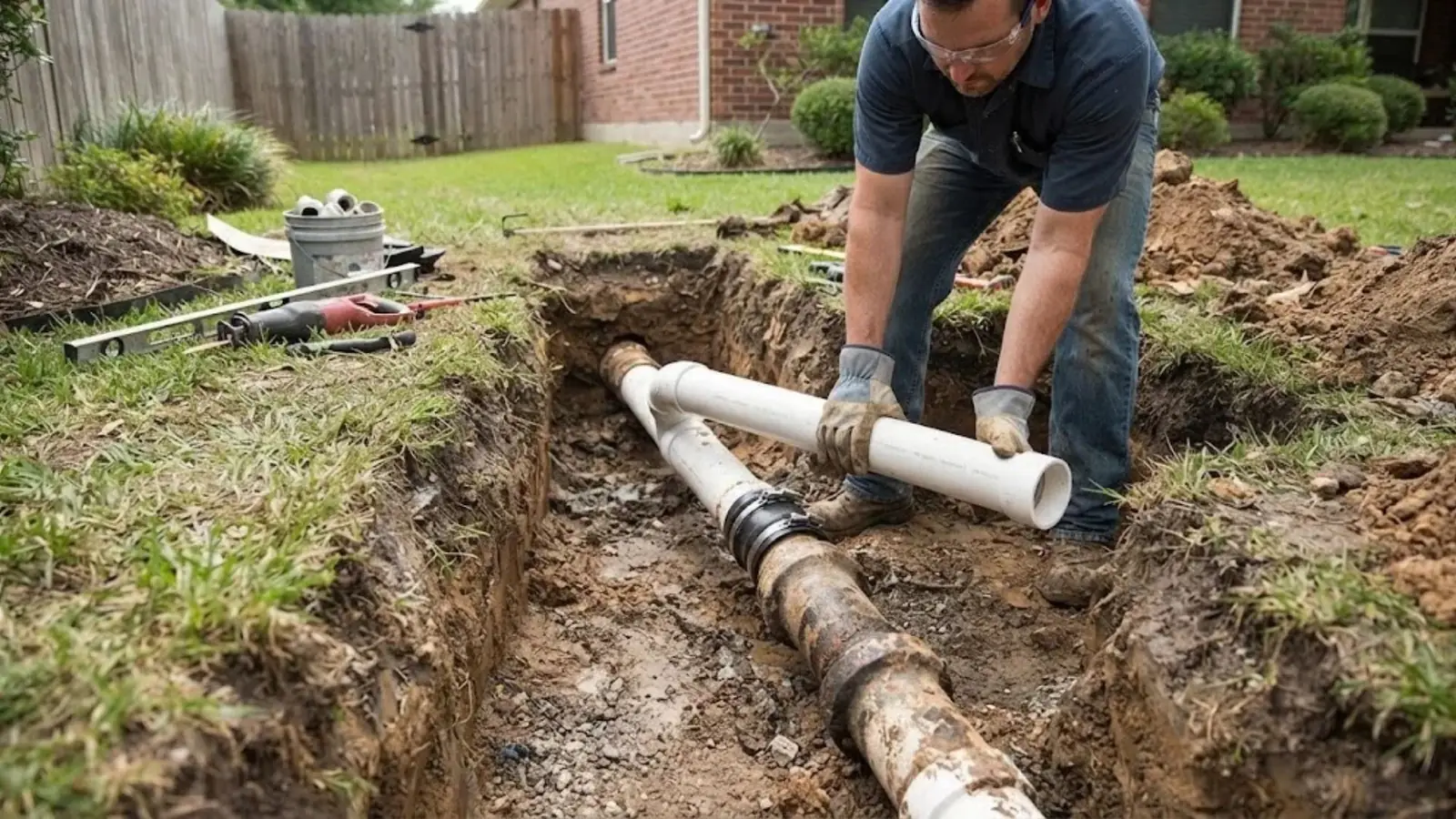
What a liner actually is
A liner is a flexible tube, usually felt, soaked with a two-part resin. Once it is inside your sewer line, the resin cures and the tube becomes a hard, smooth plastic pipe pressed against the inside wall of the old one. The trade calls this cured-in-place pipe lining.
The old pipe stays in the ground and becomes a sleeve. That is why lining can seal a crack, close the gap at a joint, and block the small openings where roots get in. It adds a tight inner wall, but it does not straighten a pipe that sags or has shifted.
Because the new wall sits inside the old one, the opening gets slightly smaller. For a typical home line that is rarely a problem, since the liner is thin and the surface is smooth. A plumber still measures the line first so the tube is cut to the right diameter and length.
The steps from camera to cured liner
Every lining job follows the same order, and skipping a step is how a liner fails early. Here is what happens on a normal job.
Camera inspection.
A camera on a push cable runs the whole line. The plumber looks for cracks, offset joints, roots, sags, and any spot where the pipe has collapsed. A sewer camera inspection also gives you a recording to keep.
Cleaning the pipe.
Roots, grease and scale get cut or jetted out so the resin bonds to bare pipe wall. A liner pulled over debris will wrinkle or leave gaps.
Measuring and mixing.
The plumber measures length and diameter, cuts the felt tube to size, and wets it out with resin. The resin has a working time, so this step is done close to the pipe.
Pulling and inflating.
The tube is pulled in through a cleanout or an access hole, then inflated with air or water so it presses against the wall.
Curing.
Heat, steam or ultraviolet light cures the resin until it is rigid. Cure time depends on the product, the pipe length and the weather, so ask for the manufacturer's method.
Reinstating the openings.
A cutter robot reopens any side connections the liner covered, such as a branch from a second bathroom. A final camera run proves the opening is clear.
Which pipe conditions suit lining and which do not
The camera footage sorts most jobs into one of a few groups. This table shows how a plumber usually reads what the camera finds.
| What the camera shows. | Lining fit. | Why. |
|---|---|---|
| Hairline cracks or open joints, pipe still round. | Good fit. | The liner seals the leak paths and bridges the joint. |
| Roots entering at joints. | Good fit after cutting. | Roots are removed first, then the liner closes the entry points. |
| One short broken or crushed section. | Spot repair often better. | A short dig can cost less than lining the whole run. |
| Belly or sag holding standing water. | Poor fit. | A liner follows the dip and the water stays. |
| Collapsed or missing pipe. | Not possible. | The tube has no wall to press against, so the pipe must be replaced. |
| Pipe too far out of round or separated. | Needs a plumber's judgment. | A large offset can snag the liner or pinch it. |
Lining, a spot repair, or digging it all up
If the damage is one short section, a spot repair with a small excavation may be the simpler fix. If the cracks and root entries run along many feet of pipe, lining one continuous sleeve usually beats digging several holes. The deciding factors are how much pipe is damaged, how deep it is, and what sits on top of it, like a driveway, a patio or a mature tree.
Full replacement makes sense when the pipe has collapsed, when it has a belly that traps water, or when the camera shows the line has pulled apart. Our sewer line repair work covers all three paths, and we explain on the call which one the footage points to. We will also say so when lining is not the right answer.
Lining does not fix a pipe with the wrong slope. It also does not fix problems on the other side of the property line. If the blockage sits in the public main, the sewer district handles it.
Why the pipe gets cleaned before it gets lined
Resin needs a clean wall to grip. Grease, scale and root fibers left behind create thin spots and wrinkles in the cured pipe. For that reason the cleaning step is part of lining, not an add-on.
Roots are worth a closer look. A plumber cuts them out with a cutter head or a jetter nozzle, then runs the camera again to confirm the wall is bare. If the roots keep returning at the same joint, that joint is a strong candidate for lining.
- Camera run before any work, with the footage saved.
- Cleaning pass that leaves bare pipe wall.
- Measured diameter and length written on the quote.
- Cured liner checked by a second camera run.
- Side connections reopened and shown on camera.
Pipe ages in Banbury Meadows and The Preserve
Banbury Meadows was built in phases from 1994 to 2019, and The Preserve was built around 2013 to 2018, so two neighbors a few miles apart can have very different sewer pipe. The street name tells you little about the material. The camera tells you the material, the joint style and the condition, which is why we read the footage before suggesting lining.
If you are buying a home in Eagle, ID, a camera run before closing costs far less than a surprise at the cleanout later. If you live closer to the Star side along State Street, our Star service page explains how that area is handled.
What drives the price of a lined sewer pipe
No honest number can come from a web page, because the footage sets the work. These are the factors that move a quote up or down.
What shapes the price.
- Length of pipe lined. Longer runs use more felt and resin and take longer to cure. A few feet and a full run to the street are very different jobs.
- Pipe diameter. Larger pipe needs a bigger tube and more material. Most house laterals are the common residential size, but the camera confirms it.
- Cleaning needed first. Heavy roots or old buildup add time with cutters or a jetter. A clean line goes faster.
- Access points. A cleanout near the house makes the pull simple. If there is none, the plumber may need to open an access point, which adds work.
- Side connections and bends. Each branch must be reopened, and tight bends slow the pull. More fittings mean more labor.
Lining an old cracked pipe is often treated as maintenance, since policies tend to exclude gradual wear, root damage and the failed pipe. Read your policy and ask your agent before the work starts.
The camera run sets everything else, so call (208) 679-8357 and we will set up the inspection.
Questions to ask any lining contractor
Lining is specialized work, and quotes vary a lot. A short list of questions separates a careful quote from a vague one.
- Can I see the camera footage that shows why lining fits this pipe?
- What material and curing method will be used, and what does the manufacturer say about it?
- How will side connections be reopened and shown to me afterward?
- What happens if the camera finds a collapse or a belly after cleaning?
- Do you verify the plumber's license with Idaho DOPL before work, and is permit work needed? Permit rules vary, so ask DOPL.
Eagle Sewer District mains and your private lateral
Sewer service in Eagle, ID, a city in Ada County, is provided by the Eagle Sewer District, and Eagle has no wastewater treatment plant of its own. Check which district serves your address before you plan any work in Eagle, ID, because some properties may be on septic instead.
Lining as described here is work on the private lateral, the pipe that leaves your house and runs toward the public main. Ask the district where its responsibility ends, since we cannot tell you that for your lot. If the stoppage or crack is in the public main, call the district rather than paying to line your own pipe.
In Star, the Star Sewer & Water District runs the water system, and in Garden City the City of Garden City provides water and sewer. The same question applies in both places, which is why our Garden City page tells you to confirm your provider first.
Common questions
Can a collapsed sewer pipe be lined?
No. A liner needs a pipe wall to press against, so a collapsed or missing section must be dug out and replaced. The camera shows this before any lining is planned.
Does lining stop tree roots from coming back?
It closes the cracks and joints where roots enter, so roots lose their way in. Roots can still grow against the outside of the pipe, but they cannot enter a sealed liner.
Who owns the sewer pipe on my property in Eagle, ID?
Ask the Eagle Sewer District where its responsibility ends, since that varies by property. In general the pipe from your house to the connection is yours, and the public main belongs to the district.
Do I still need a camera inspection if I know the pipe is old?
Yes. Age alone does not tell you if a pipe is cracked, collapsed or fine. The camera shows the real condition and decides between lining, spot repair and replacement.
How long does a lined pipe last?
It depends on the product and the condition of the host pipe, so ask for the manufacturer's stated service life in writing. We do not promise a number from this page.
Does lining need a permit in Idaho?
In Idaho the state Division of Occupational and Professional Licenses issues plumbing permits, not the city. What a job needs depends on the work, so ask DOPL at 208-334-3233 or have your plumber confirm.
If your sewer line keeps backing up or the camera has shown cracks, call (208) 679-8357 and we will set up the inspection.
Call (208) 679-8357Standards and sources
Plumbing work in Idaho follows the state plumbing code, which is based on the 2015 Uniform Plumbing Code (UPC) with state amendments in IDAPA 24.39.20. Permits and licenses come from the Idaho Division of Occupational and Professional Licenses (DOPL), not the city.
- Idaho DOPL plumbing FAQs (state agency)
- IDAPA 24.39.20 Idaho State Plumbing Code (state rule)