
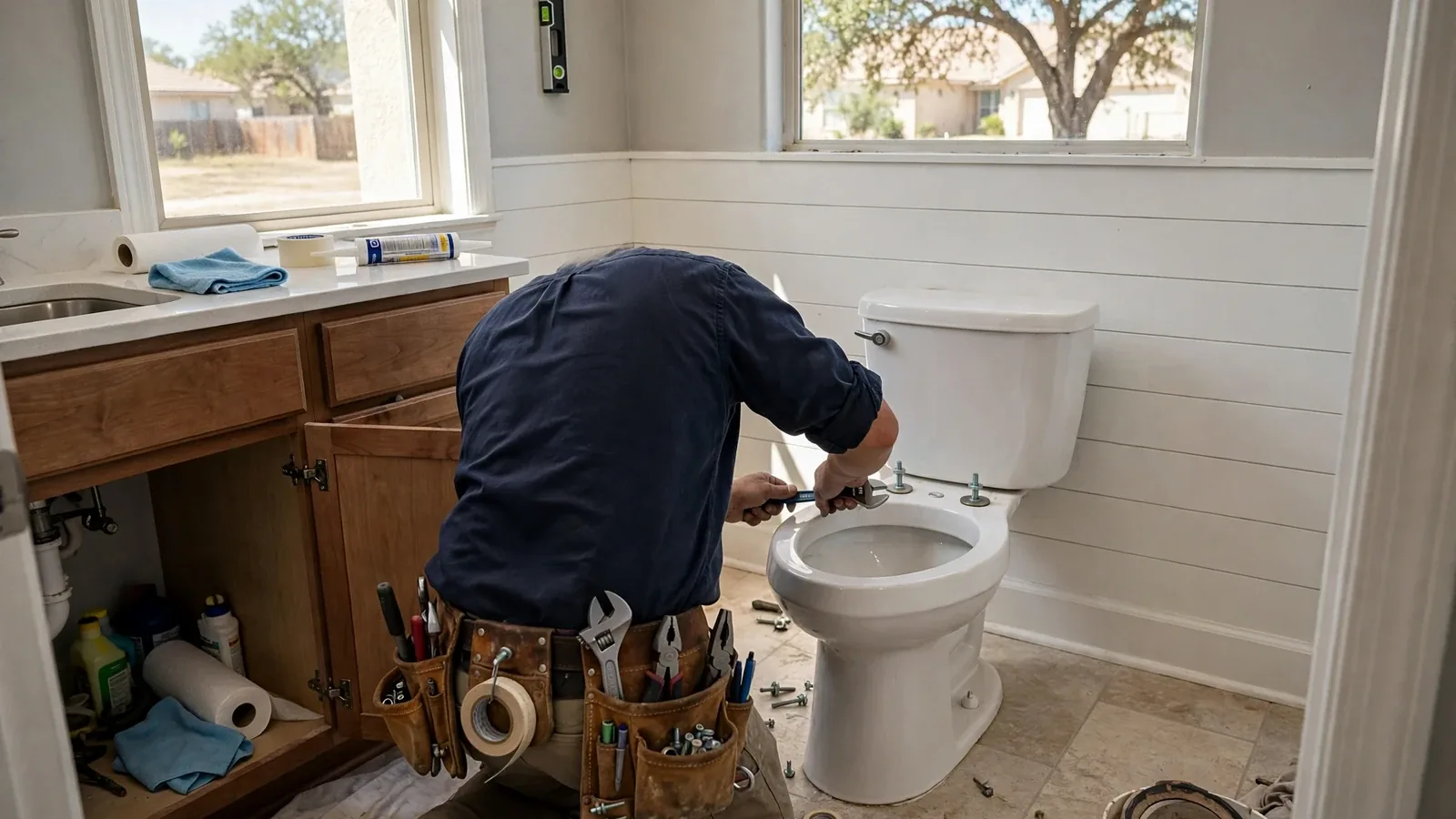
The parts that make a toilet work
Two connections matter. Clean water comes in through the supply line, and waste goes out through the drain. Everything else is hardware to hold the toilet down and keep the two connections sealed.
- Shutoff valve on the wall or floor, which lets you stop the water to the toilet alone.
- Supply line, a short braided or rigid tube from the shutoff to the tank fill valve.
- Closet flange, a ring fixed to the floor over the drain pipe.
- Wax ring or equivalent seal, which sits between the flange and the bowl outlet.
- Closet bolts, two bolts set in the flange slots that hold the bowl down.
- Bowl and tank, joined by bolts and a gasket or sealing washer.
Rough-in distance: measure before you buy
Rough-in is the distance from the finished wall behind the toilet to the center of the flange. The common standard is 12 inches. Some older or special bathrooms use 10 or 14, and a toilet built for 12 will not sit right on a 10.
Measure to the flange center, not to the baseboard. If you measure to the edge of a baseboard, you will be off by the thickness of the trim. Write the number down before you shop.
| Measured distance. | What it means. | What to buy. |
|---|---|---|
| About 12 inches. | Standard rough-in. | A standard 12 inch toilet. |
| About 10 inches. | Tight rough-in. | A toilet made for 10 inches. |
| About 14 inches. | Wide rough-in. | A toilet made for 14 inches. |
| Anything else. | Unusual or damaged layout. | Stop and ask a plumber. |
Gather these before you pull the old toilet
- New toilet, still boxed, with its bolts and hardware.
- New wax ring and closet bolts, sized to the flange.
- New supply line and, if the old valve is stiff or leaking, a new shutoff.
- Adjustable wrench, screwdriver, putty knife and a level.
- Bucket, sponge, old towels and rubber gloves.
- A rag to stuff the drain opening while the toilet is off, so sewer gas stays out.
Porcelain is heavy and slippery. Get a helper for the lift, and bend at the knees. A dropped bowl is a ruined bowl and a hurt foot.
Setting the toilet, step by step
Shut off and drain.
Close the shutoff valve, flush, and sponge the tank and bowl until they are nearly dry.
Disconnect and lift.
Remove the supply line and the nuts on the closet bolts, then lift the old toilet straight up and carry it off.
Clean the flange.
Scrape off the old wax with a putty knife and look at the flange. It should be firm, level and not cracked.
Set the bolts and seal.
Put new closet bolts in the flange slots, stuff the rag out of the way and set the wax ring on the flange or the bowl outlet.
Lower the bowl.
Line the bowl over the bolts, press straight down with your weight and do not rock it. The wax needs one clean seat.
Tighten and connect.
Add washers and nuts, then tighten each side a little at a time until the bowl stops moving. Stop before the porcelain strains.
Add the tank and supply.
Bolt the tank to the bowl if it is separate, connect the supply line and open the shutoff slowly.
Testing: how to know the seal and the tank are tight
Let the tank fill and watch the supply connection and the base for drips. Flush several times and wipe the floor around the base with dry tissue after each one. A damp spot means the seal or a nut needs attention.
For the tank itself, use the EPA dye test. Put a few drops of food coloring in the tank and wait 10 minutes without flushing. If color shows in the bowl, the flapper leaks. The EPA says household leaks waste more than 9,300 gallons a year on average, so a silent flapper leak is worth fixing.
Mistakes that cause leaks weeks later
- Overtightening the bolts until the porcelain cracks.
- Rocking the bowl after it touches the wax, which breaks the seal.
- Reusing an old wax ring.
- Setting the toilet on a flange that sits below the finished floor.
- Leaving the supply line twisted or kinked.
- Skipping the level check, which leaves the bowl rocking on its base.
A slow base leak is dangerous in a quiet way. Water soaks the subfloor, and the damage can run for months before a stain shows.
When to stop and call a plumber
Call if the flange is cracked or rusted, if the floor around it is soft, or if the toilet keeps rocking after you shim it. Call if the drain gurgles, backs up or smells after you set the toilet, because that points to a venting or drain problem behind the wall. Call if you want to move the toilet to a new spot, since a new drain and vent are involved.
What a plumber charges depends on a few things. They include flange repair, subfloor damage, a new shutoff valve, how hard the bathroom is to reach and whether the toilet moves. For repairs to an existing toilet, see toilet repair. For new bathroom work, see plumbing installation.
Doing your own toilet work in Eagle, ID: the DOPL permit
Plumbing permits in Idaho are sold by the Division of Occupational and Professional Licenses (DOPL), and the city has no say. An owner may buy one to work on their own primary or secondary residence, in Eagle, ID or elsewhere in Ada County, though commercial buildings are excluded. Your city or county building permit cannot take the place of the DOPL permit.
Once bought, a DOPL permit runs a year from purchase or from the last inspection, and you request inspections by phone or online. The state code underneath it all is the 2015 Uniform Plumbing Code. Whether a like-for-like toilet swap needs a permit at all is a fair question for DOPL at 208-334-3233.
Homes in The Preserve were built about 2013 to 2018, and Banbury Meadows homes date from 1994 to 2019. Floors, flanges and shutoff valves in homes of different eras are not the same, so check yours with a flashlight before buying parts. Our plumbers also serve Star and Garden City.
Common questions
How far should a toilet flange be from the wall?
The common standard is 12 inches from the finished wall to the center of the flange. Some bathrooms use 10 or 14, so measure before you buy.
Can I reuse the old wax ring?
No. Wax compresses when the toilet is set and will not seal the same way twice. A new ring is a small part and protects the floor.
How tight should the closet bolts be?
Snug, in small turns on each side, until the bowl stops moving. Overtightening is the usual way people crack a bowl.
Why does my toilet rock after I install it?
The flange may sit too low or too high, or the floor may be uneven. Shims under the base can help with a small gap, but a bad flange needs repair.
Do I need a permit to set a toilet at my home in Eagle, ID?
Homeowners can buy a DOPL permit for their own residence. Whether a toilet swap needs one is DOPL's call at 208-334-3233.
What does it mean if my toilet gurgles after I set it?
Gurgling often means the drain or vent is not moving air or water freely. If it continues after a flush, call a plumber.
If the flange looks bad or the toilet will not sit right, tell the dispatcher what you see at (208) 679-8357.
Call (208) 679-8357Standards and sources
Plumbing work in Idaho follows the state plumbing code, which is based on the 2015 Uniform Plumbing Code (UPC) with state amendments in IDAPA 24.39.20. Permits and licenses come from the Idaho Division of Occupational and Professional Licenses (DOPL), not the city.
- Idaho DOPL plumbing FAQs (state agency)
- IDAPA 24.39.20 Idaho State Plumbing Code (state rule)
- U.S. EPA: Fix a Leak Week (federal agency)