
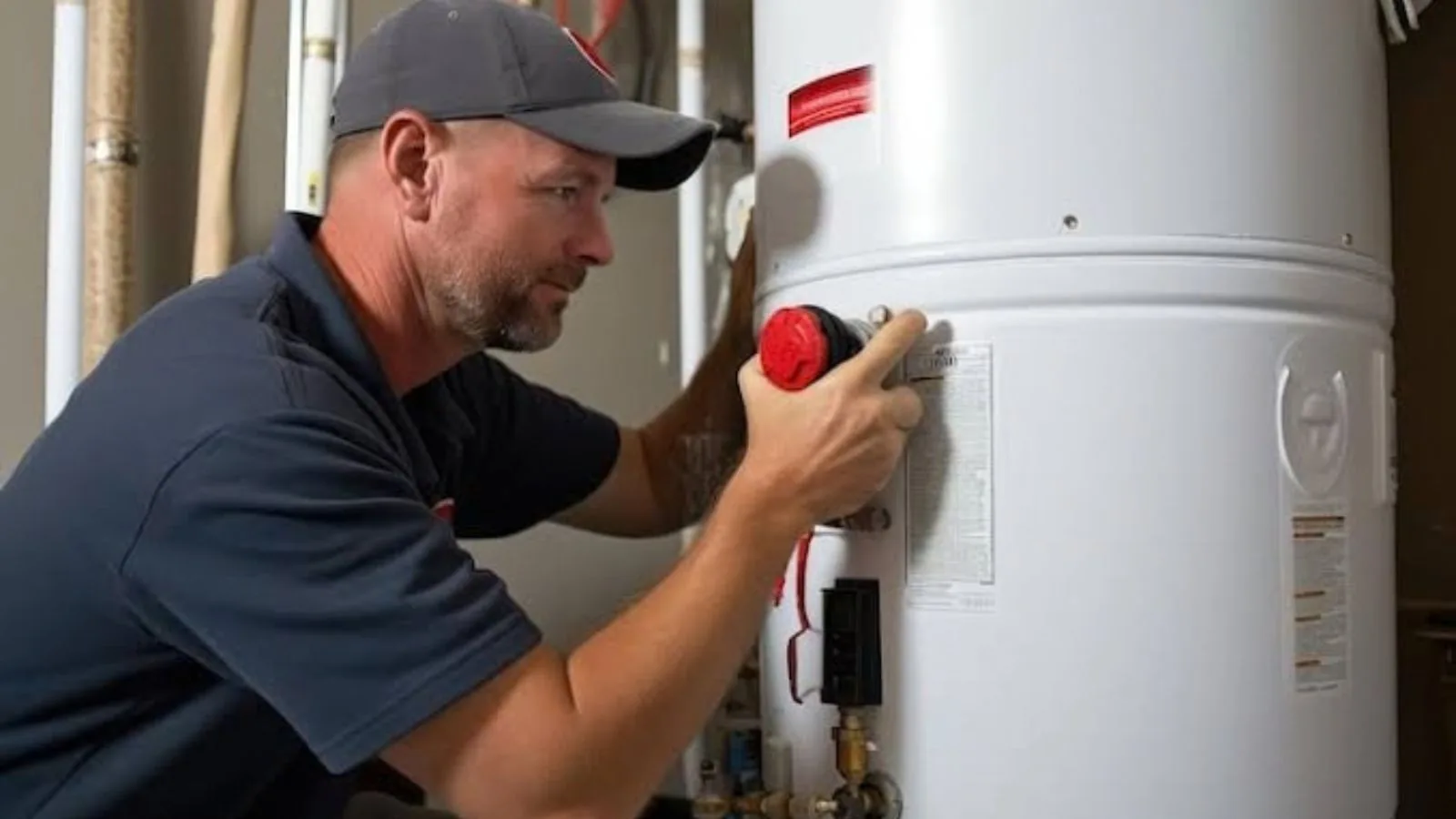
The 10 to 15 year range and what moves you inside it
The Department of Energy puts storage tank heaters at 10 to 15 years and tankless at about 20. That is a range, not a deadline. A tank that was flushed, sits in a dry room and runs on steady water pressure may reach the far end. A tank that was ignored often fails sooner.
The part that wears out is the steel tank itself. Inside, a thin glass lining protects the steel from the water, and over time the lining cracks and rust begins. Once the tank wall leaks, no fitting or valve will cure it.
That is why a heater at 12 years with a small drip at the bottom is a replacement, and a heater at 6 years with a bad thermostat is a repair. The age and the failed part tell the story together.
How to read your heater's age from the label
Most heaters do not print a plain install date. They carry a serial number that encodes the build month and year. Makers use different formats, so you need the label and the maker's own decoder.
- Turn off the power or gas supply if you have to move anything, and keep your hands clear of the vent.
- Find the rating label on the side of the tank, often near the top.
- Write down the serial number exactly, including letters.
- Check the maker's website or manual for how it encodes the date. A letter for the month and two digits for the year is common, but formats differ.
- Add the age to what you know about the install. A heater swapped later than the house was built is younger than the house.
If the label is unreadable or rusted, say so when you call. A plumber can often narrow the age from the model line and the look of the fittings, though a decoded serial number is firmer.
Warning signs and what each one usually means
Some signs point to a small part and some point to a dying tank. This table separates the two so you do not replace a heater that only needs a thermostat.
| Sign. | Usual meaning. | Repair or replace. |
|---|---|---|
| Water pooling under the tank. | Tank wall or lower fitting leak. | Replace if the tank itself leaks. |
| Rust-colored hot water only. | Corroding tank interior or anode rod gone. | Replace if the heater is old. |
| Popping or rumbling. | Sediment hardened on the tank bottom. | Flush and watch, or replace if old. |
| Lukewarm water. | Failed element, thermostat or gas parts. | Usually repair. |
| Leak at a pipe connection on top. | Loose or worn fitting or relief valve. | Usually repair. |
Check the cold and hot lines on top of the tank first. Many leaks that look like a dead tank are only a dripping connection. If you are unsure where the water comes from, dry the area and watch for the first bead.
The anode rod and the flush that buy you extra years
Inside most tanks hangs a metal anode rod. It corrodes on purpose, so the tank steel does not. When the rod is used up, the tank starts to rust instead. Checking the rod and replacing it costs less than a new heater, but only if you do it before the tank is already eaten through.
Sediment builds on the bottom of the tank and forces the burner or lower element to work harder. A flush drains some of it out. Follow your manufacturer's manual for how often to flush and how, because instructions vary by model.
- Look at the tank base and the floor around it every few months.
- Test the relief valve by lifting its lever briefly, if the manual says it is safe, and make sure it drains to a pipe.
- Keep storage away from the heater, so you can see leaks and reach the valves.
- Write the install date on the tank with a marker so no one has to decode it later.
Repair or replace: a rule that holds up
Replace when the tank leaks, when the heater is at the far end of its range and has a second problem, or when it can no longer keep up with your household. Repair when the tank is sound and the failure is a part: an element, a thermostat, a thermocouple, a relief valve.
Cost depends on a few things, and we will not guess at a number here. The size and fuel of the heater, the venting and gas or electric connections, the permit, the condition of the old shutoff valves and whether the heater has to move all change the price. A plumber can give you a clear price before work starts once the details are known.
If you are not sure which side your heater falls on, talk through the symptoms with a licensed plumber. You can read more about water heater replacement or about repair options before you call.
Tankless heaters live longer, with their own upkeep
The Department of Energy puts tankless life at about 20 years. They have no big tank to rust through, so the aging parts are the heat exchanger, the burner and the sensors. Scale inside the heat exchanger is the usual wear item, and it depends on your water.
That means a tankless unit is not maintenance-free. Follow the maker's manual for descaling, and ask your water utility for its water quality report to learn how scale-prone your supply may be.
Replace it before it floods the garage
A planned swap is calmer than a failed one. A heater that dies on a weekend can drain a full tank across the floor before you find it. With time, you can pick the size, check the venting and have the old shutoffs replaced in the same visit.
If water is already on the floor, shut off the cold supply to the heater, turn off the gas or the breaker, and call. Our 24/7 dispatch line takes those calls, and same-day appointments are available when schedules allow.
Water heater ages in Eagle, ID homes from The Shores to Two Rivers
Many custom homes in The Shores were built from 2006 to 2019, and Two Rivers homes were built roughly from 2000 to 2017. With a 10 to 15 year range, a heater installed when a Shores house went up in 2006 is now about 20 years old if it was never swapped. A heater from a 2013 build is mid-to-late life, which is the time to check the label.
If your heater sits in the garage, this matters. Idaho's State Plumbing Code amends the 2015 Uniform Plumbing Code so that in residential garages, burners and ignition sources must sit at least 18 inches above the floor, unless the heater is listed as flammable vapor ignition resistant (section 507.13). Check where your gas burner sits. A replacement in an Eagle, ID garage has to meet that rule, and an old heater sitting on the floor may not.
Our plumbers also work in Eagle, ID neighbors Star and Garden City, both in Ada County. Garden City has much housing from the postwar decades through the 1980s, so heater ages there run across a wider spread.
Common questions
How long does a water heater last?
The U.S. Department of Energy says storage tank heaters last 10 to 15 years and tankless heaters about 20. Water conditions, flushing and tank location can pull a unit to either end of that range.
How can I tell how old my water heater is?
Read the serial number on the rating label and look up the maker's date code. Most makers encode the build month and year in it, but formats differ, so check the manual or the maker's website.
Is rust-colored hot water a sign my heater is dying?
It can be, especially in an older tank, because it often means the tank interior is corroding. Check whether the cold water is also rusty, since that points to the pipes instead of the heater.
Can I just replace the anode rod to keep an old heater going?
Sometimes, if the tank is sound. A rod change cannot fix a tank that already leaks or is rusted through, so a plumber should look at the tank first.
Does my garage water heater in Eagle, ID need to sit off the floor?
Under an Idaho plumbing code amendment, a garage heater's burner and ignition source must be at least 18 inches off the floor, unless the heater is listed as flammable vapor ignition resistant. Check your model's listing or ask a licensed plumber.
Should I replace a 12 year old heater that still works?
Not automatically. If the tank is dry and the heater performs, you can keep it and plan the swap. Check the base for drips often, since that is where failure shows first.
If your heater is near the end of its range or already dripping, give the age and the symptom to the dispatcher at (208) 679-8357.
Call (208) 679-8357Standards and sources
Plumbing work in Idaho follows the state plumbing code, which is based on the 2015 Uniform Plumbing Code (UPC) with state amendments in IDAPA 24.39.20. Permits and licenses come from the Idaho Division of Occupational and Professional Licenses (DOPL), not the city.
- U.S. DOE: Sizing a New Water Heater (federal agency)
- U.S. DOE: Which Water Heater Is Right for You (federal agency)
- IDAPA 24.39.20 Idaho State Plumbing Code (state rule)