
What to do the moment you smell gas
These are the steps Intermountain Gas publishes for a gas smell inside a building. Follow them in this order, and do not stop to gather belongings.
Leave first, call second.
Get everyone out right away, including pets, and leave the door open as you go. Call from outside and away from the leak. Call Intermountain Gas's 24-hour emergency number, 800-548-3679, and call 911 for the fire department.
- Do not use a phone inside the building.
- Do not operate light switches, plugs or garage door openers.
- Do not open or close windows.
- Do not smoke or light matches.
- Do not go back in until you are told it is safe.
A spark from a switch or a garage opener can ignite gas that has built up. That is why even small actions inside the house wait until you are outside. We do not promise any response time for the utility or the fire department, and we do not tell you to go back in.
Signs of a gas leak
Utilities add a strong odor to natural gas so people notice leaks. Many people describe it as a rotten egg smell. Your nose is not the only clue.
- A rotten egg or sulfur smell near an appliance, a meter or a pipe.
- A hissing or whistling sound near a gas line or fitting.
- Dead or discolored plants in a line over a buried pipe.
- Bubbles in standing water or wet ground near a gas line.
- A gas appliance flame that burns yellow or orange instead of blue.
Treat any of these as a reason to call. A smell you cannot trace and a faint smell near the meter outside both belong to the utility, not to a homeowner with a wrench.
Why we do not start with a plumber
People are surprised that we tell them to call someone else first. The utility has gas detectors, shutoff authority at the meter, and a process for deciding the building is safe. A plumber does not replace that, and entering a gas-filled house to look around puts the plumber and you at risk.
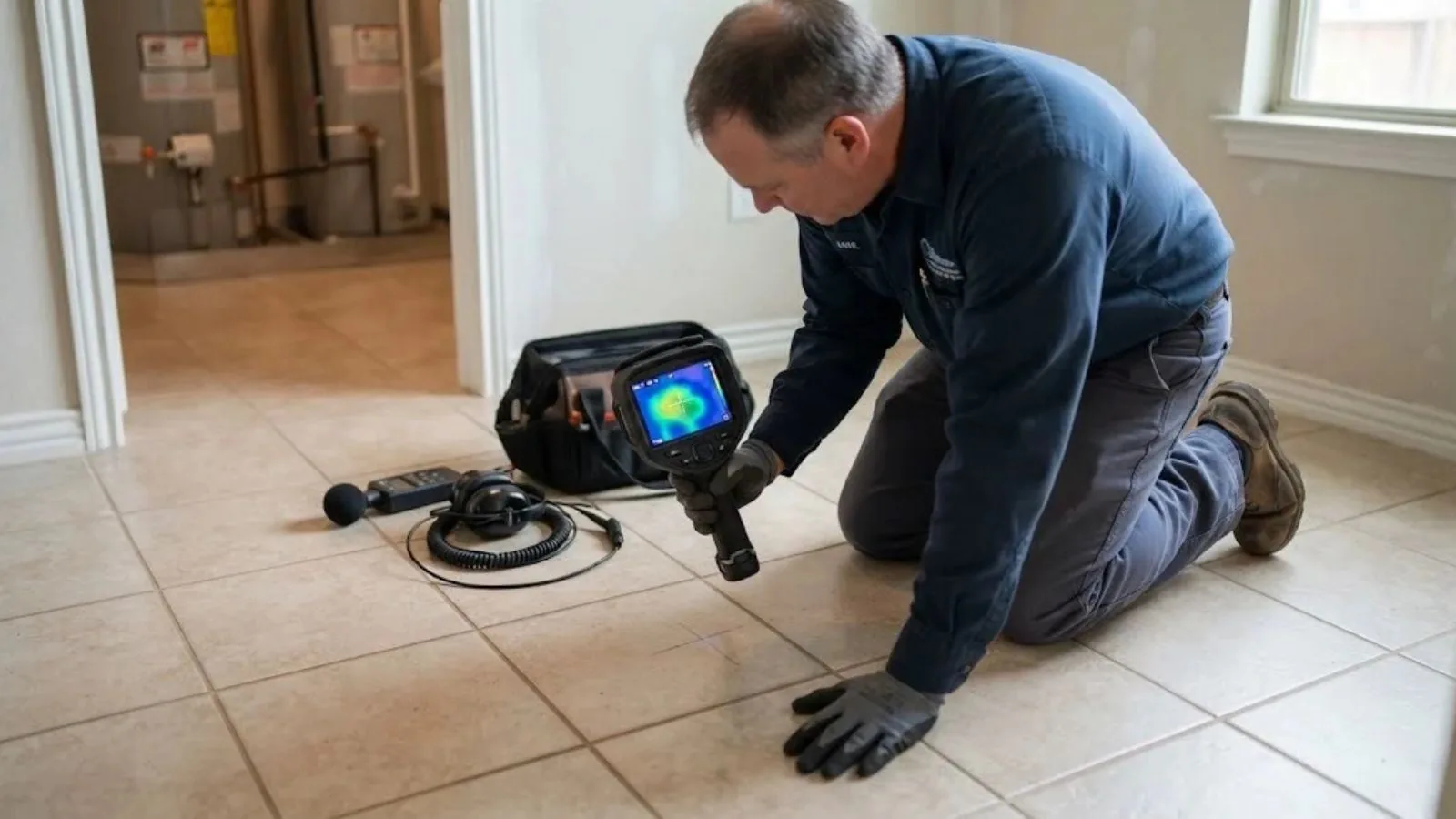
After the utility has cleared your home, we can come in and test the house piping. Our plumbing installation work includes gas piping, so we can inspect, repair and test the lines inside the building. We can also check the appliance connections that the utility does not touch.
What a licensed plumber can test after the all-clear
Once the building is safe, the plumber works from the meter toward the appliances. The goal is to find the leak, fix it, and prove the repair holds.
| Check. | What it shows. | Notes. |
|---|---|---|
| Combustible gas detector. | Gas concentration at a joint or valve. | Used to sniff along fittings and connectors. |
| Leak detection solution. | Bubbles at a leaking joint. | Brushed on a fitting and watched. |
| Pressure test. | A drop in pressure over time in the house piping. | Done with the system isolated from the meter. |
| Appliance connection check. | Worn flex connectors and loose unions. | Common spot for slow leaks. |
| Visual pipe review. | Corrosion, damage and missing supports. | Looks at exposed pipe in garage and utility areas. |
A pressure test is the most telling, because a slow leak can hide from a nose. If the gauge falls with the supply closed, the pipe or a fitting is leaking somewhere in between. Our leak detection team uses the same pressure-test approach on water lines, and the idea carries over.
What happens after the leak is found
Repair depends on where the leak is. A loose union or a worn appliance connector is a short fix. A corroded section of pipe, a bad valve or a damaged line behind a wall takes more work and may need parts.
After any repair, the line should be tested again before the gas is restored. Permit rules vary, so ask the Idaho Division of Occupational and Professional Licenses (DOPL). Anyone can check a plumber's license with DOPL, and you should before you hire for gas work.
Utility clears the home.
Intermountain Gas confirms it is safe to enter.
Plumber isolates the system.
The gas is shut at the appliance valves or the meter.
Leak is located and repaired.
A licensed plumber fixes the fitting, connector or pipe.
Pressure test and re-check.
The line is tested before gas service resumes.
Carbon monoxide is a different hazard
Carbon monoxide has no smell and does not come from a leaking pipe. It comes from fuel that does not burn fully in a furnace, water heater, stove or fireplace. A gas smell and a CO alarm are two separate warnings.
If a carbon monoxide alarm sounds, or anyone has a headache and nausea that clears outside, leave the home and call 911. A CO alarm is not a gas leak detector, and a gas detector is not a CO alarm. Having both in the house is reasonable.
What drives the cost of finding and fixing a gas leak
No dollar figures belong on a safety page. These are the real factors that decide a bill.
- How much piping must be tested and how hard it is to reach.
- Whether the leak is at an appliance connector or inside a wall.
- Pipe material and condition, and whether a section must be replaced.
- Parts, such as valves and connectors, and the time to pressure test.
- Whether the work needs a permit through DOPL.
Homeowners insurance usually covers sudden accidental damage and often excludes wear and the failed part itself. Read your policy, and call (208) 679-8357 for the real number after the utility has cleared the home.
Gas in Eagle, ID: Intermountain Gas and 911
Natural gas in Eagle, ID is supplied by Intermountain Gas Company. Its 24-hour emergency number is 800-548-3679. Save it in your phone now, because you should not use a phone inside the building during a leak.
Eagle is a city in Ada County, and homes along State Street and Eagle Road are handled the same as homes in The Shores or Banbury Meadows. The steps do not change by neighborhood, and the meter is the utility's to shut off. If a gas smell is outside near the meter, call the same number and 911 for the fire department.
Common questions
Who do I call first if I smell gas in Eagle, ID?
Get everyone out, then call Intermountain Gas at 800-548-3679 and 911 from outside. Do not call a plumber until the utility has cleared the home.
Can I find a small gas leak myself?
Do not try with matches or flames. A small leak is still a fire risk. Leave detection to the utility and a licensed plumber with gas detectors and test gauges.
Does a gas smell outside need the same response?
Yes. A smell near the meter or a yard line still gets a call to the utility and 911. Stay away from ignition sources.
Can you test my gas piping after the utility clears it?
Yes. A licensed plumber can pressure test the house piping and check the appliance connections. Call (208) 679-8357 after the utility says the home is safe.
Is carbon monoxide the same as a gas leak?
No. Carbon monoxide has no smell and comes from incomplete burning. It needs a CO alarm, and a gas leak needs the utility.
Can you check my gas line if I live outside Eagle?
Ask us when you call (208) 679-8357. We serve Star and Garden City as well, and the utility steps stay the same, so call your gas provider first.
Once the utility has said your home is safe, call (208) 679-8357 and we will schedule the piping test.
Call (208) 679-8357Standards and sources
Plumbing work in Idaho follows the state plumbing code, which is based on the 2015 Uniform Plumbing Code (UPC) with state amendments in IDAPA 24.39.20. Permits and licenses come from the Idaho Division of Occupational and Professional Licenses (DOPL), not the city.
- Intermountain Gas Company: emergency information (utility)
- Idaho DOPL plumbing FAQs (state agency)