
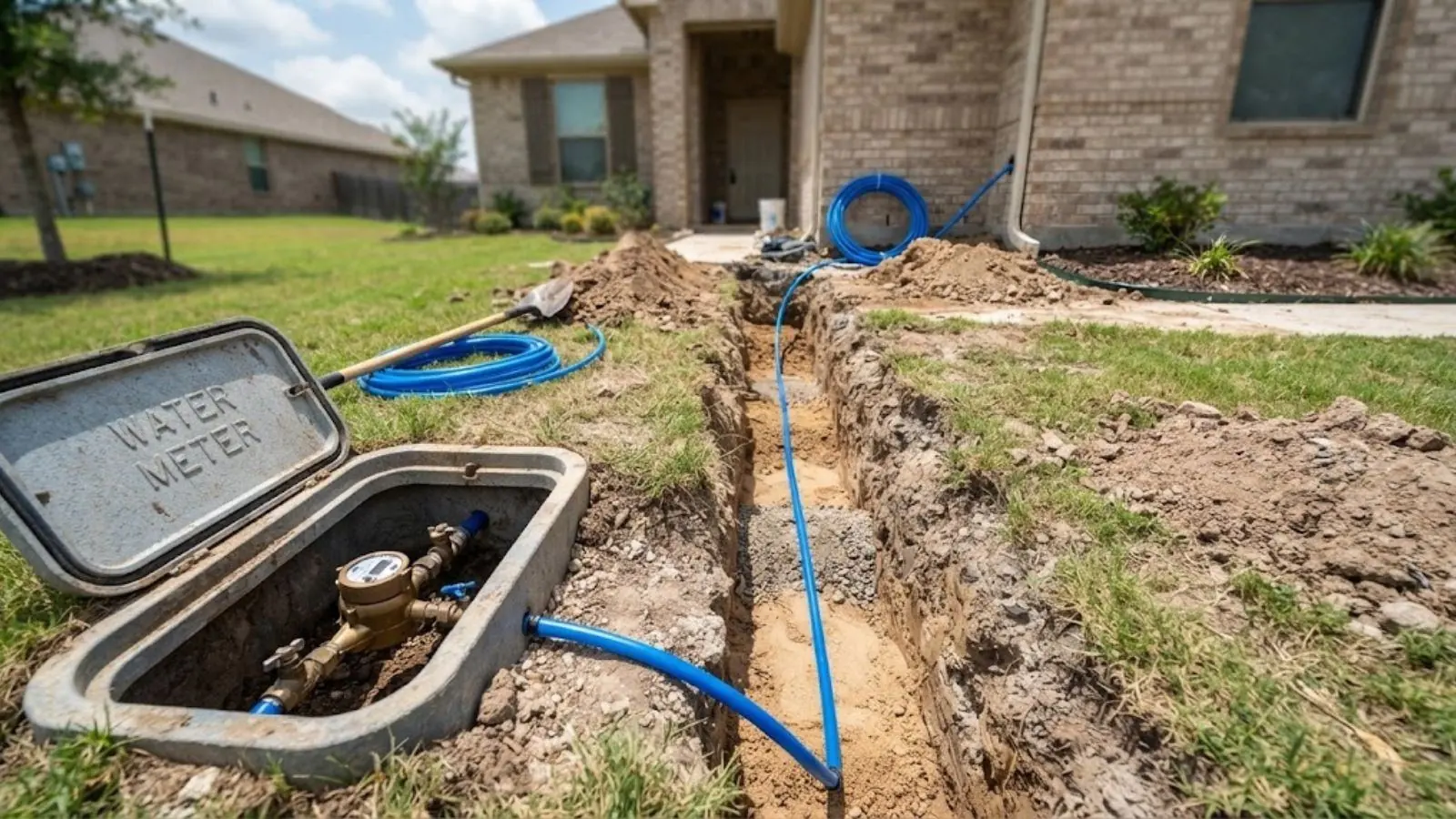
Signs that water is escaping underground
Buried leaks rarely announce themselves. They show up as side effects, and one sign alone proves little. Two or three together make a strong case.
- The meter dial or digital flow indicator moves when everything is off.
- A water bill that jumped with no change in how your family uses water.
- A soft, soggy or unusually green patch of lawn when nearby grass is dry.
- Low pressure at every faucet, not just one.
- A hissing or rushing sound near the meter or where the line enters the house.
- Wet pavement or a dark stain along a driveway edge with no rain.
A soggy patch does not always sit right over the leak. Water follows the easiest path through soil, gravel and pipe trenches, so the wet spot can be several feet from the break.
The meter test, step by step
The U.S. Environmental Protection Agency gives a simple meter test that works for most homes. It tells you if a leak exists, and it takes about two hours of waiting.
Stop all water use.
Turn off faucets, the dishwasher, washer, ice maker and irrigation. Make sure no one flushes a toilet.
Read the meter.
Write down the full reading, including any small dial or flow triangle that spins when water moves.
Wait two hours.
Use no water at all in that time.
Read it again.
If the reading has changed, you probably have a leak, according to the EPA.
Do a quick toilet check too, because a leaking flapper is the most common cause of a moving meter. Put a few drops of food coloring in the tank, wait 10 minutes without flushing, and look for color in the bowl. If the bowl stays clear and the meter still moves, the leak is likely in a pipe or outdoors.
Service line or sprinkler line
Two separate pipe networks run under many Eagle yards. One is the water service line that feeds your house from the meter. The other is the irrigation system, and in The Shores and Banbury Meadows it runs on pressurized irrigation, a second pipe network that can leak on its own.
Separating them is a matter of valves. Close the irrigation supply and repeat the meter test. If the meter stops, the leak is on the sprinkler side, and if it keeps moving, the leak is likely on the house line or inside the house. A plumber also checks the pressure on each side with a gauge.
| What you see. | Likely pipe. | Quick check. |
|---|---|---|
| Meter moves, irrigation shut off. | House line or indoors. | Close the main valve at the house and watch the meter. |
| Meter stops after closing the sprinkler valve. | Irrigation line. | Look for wet zones when the system runs. |
| Wet spot between meter and house. | Water service line. | Compare pressure at the hose bib and inside. |
| Wet only when zones run. | Sprinkler head or lateral. | Run one zone at a time. |
How a plumber pinpoints a buried leak
Once the pipe is identified, the job is to find the exact spot so one small hole can fix it. Plumbers use more than one method because no single tool works on every pipe.
Acoustic listening
A ground microphone or contact sensor picks up the hiss or rush that pressurized water makes as it escapes. The plumber walks the line and listens for the loudest point. Plastic pipe and soft soil carry sound poorly, so this method is strongest on metal pipe and near fittings.
Tracer gas
For hard cases, the line is drained and filled with a harmless gas mix, and a sensitive detector sniffs the ground for it. Gas finds leaks that make little sound, which is common on plastic. Pipe locators and pressure tests round out the kit, and thermal imaging can help with hot water lines.
If you want the full process behind this work, our leak detection service page covers the tools in more detail.
Call 811 before anyone digs
Digging near your meter or driveway in Eagle, ID can hit gas, electric, telecom or other buried lines. Call 811 before any digging, even for a shallow repair, so utilities can mark their lines.
That rule applies to a homeowner with a shovel as much as to a contractor with a backhoe. Leak repairs also raise a boundary question. Ask your utility where its responsibility ends, because we cannot tell you that for your lot.
Do this first, and stop here
You can safely close your main shutoff valve, run the meter test, look at toilets, and check the irrigation controller. Those steps cost nothing and give a plumber a head start.
Where to stop.
Do not dig up a suspected line, cut into a slab, or open the meter box yourself. The meter is the utility's equipment to ask about, and a wrong cut can flood the yard or damage another buried line.
If the main shutoff valve at the house will not turn or does not stop the flow, that is a water line repair call. We can tell you what to do while you wait.
What a leak search costs, in drivers
We do not quote numbers on a web page. These are the factors that decide the price of a search and a repair.
- How much of the pipe run needs to be listened to or scanned.
- Pipe material, since plastic is harder to hear than metal.
- Depth and surface, such as lawn, gravel, driveway or concrete.
- Whether the leak is on the sprinkler side or the house line.
- How much digging, patching and restoring the repair needs.
Insurance often responds to sudden accidental damage and often excludes gradual leaks and the failed pipe itself, so read your policy. The bill for a search is usually a separate line from the repair, and the call to (208) 679-8357 gets you the actual figure.
Who supplies your water in Eagle
Which pipe belongs to whom starts with who delivers your water. In Eagle, ID, water comes from Veolia Water Idaho, from the City of Eagle's own water system, or from a private well in some outlying areas. The answer depends on your address, so check your bill or ask your utility.
That matters for a leak. If the meter is the utility's and the leak is on its side of the meter, the repair is the utility's job. If you have a private well, there is no meter, so the pressure tank and pump become part of the search. Always call 811 before digging anywhere in Ada County.
Homes near Laguna Pointe or the Boise River Greenbelt sit close to open water, so a wet spot there is easy to blame on the river. Run the meter test before you assume, because it tells you if the water came from your own pipes.
Common questions
How do I know if there is a leak under my yard?
Run the EPA meter test. If the reading moves after two hours with all water off, you likely have a leak. A soggy lawn patch or low pressure adds weight.
Can I find a buried leak without digging?
Usually yes. Acoustic listening, tracer gas, pipe locators and pressure tests narrow the spot so only a small hole is needed.
Who do I call first about a leak in Eagle, ID?
Shut off your main valve at the house if water is flowing, then call a plumber. Ask your water utility, Veolia Water Idaho or the City of Eagle, where its responsibility ends. If the leak is at or before the meter, tell the utility.
Does a high water bill always mean an underground leak?
No. Irrigation use, a running toilet and a dripping faucet are more common causes. The meter test sorts them out quickly.
Is a leak on the sprinkler line covered by the same repair?
It is a separate network from your house line. A plumber can test both, and irrigation repair is a different trade, so we will tell you honestly which side the leak is on. Homeowners in Star service area and Garden City can follow the same steps.
What does EPA say about leak waste?
The EPA says household leaks waste more than 9,300 gallons a year on average, and fixing easy leaks can cut a bill by about 10 percent.
If the meter test says water is leaving your pipes, call (208) 679-8357 and we will help you decide between the house line and the yard.
Call (208) 679-8357Standards and sources
Plumbing work in Idaho follows the state plumbing code, which is based on the 2015 Uniform Plumbing Code (UPC) with state amendments in IDAPA 24.39.20. Permits and licenses come from the Idaho Division of Occupational and Professional Licenses (DOPL), not the city.
- U.S. EPA: Fix a Leak Week (federal agency)
- Idaho DOPL plumbing FAQs (state agency)