
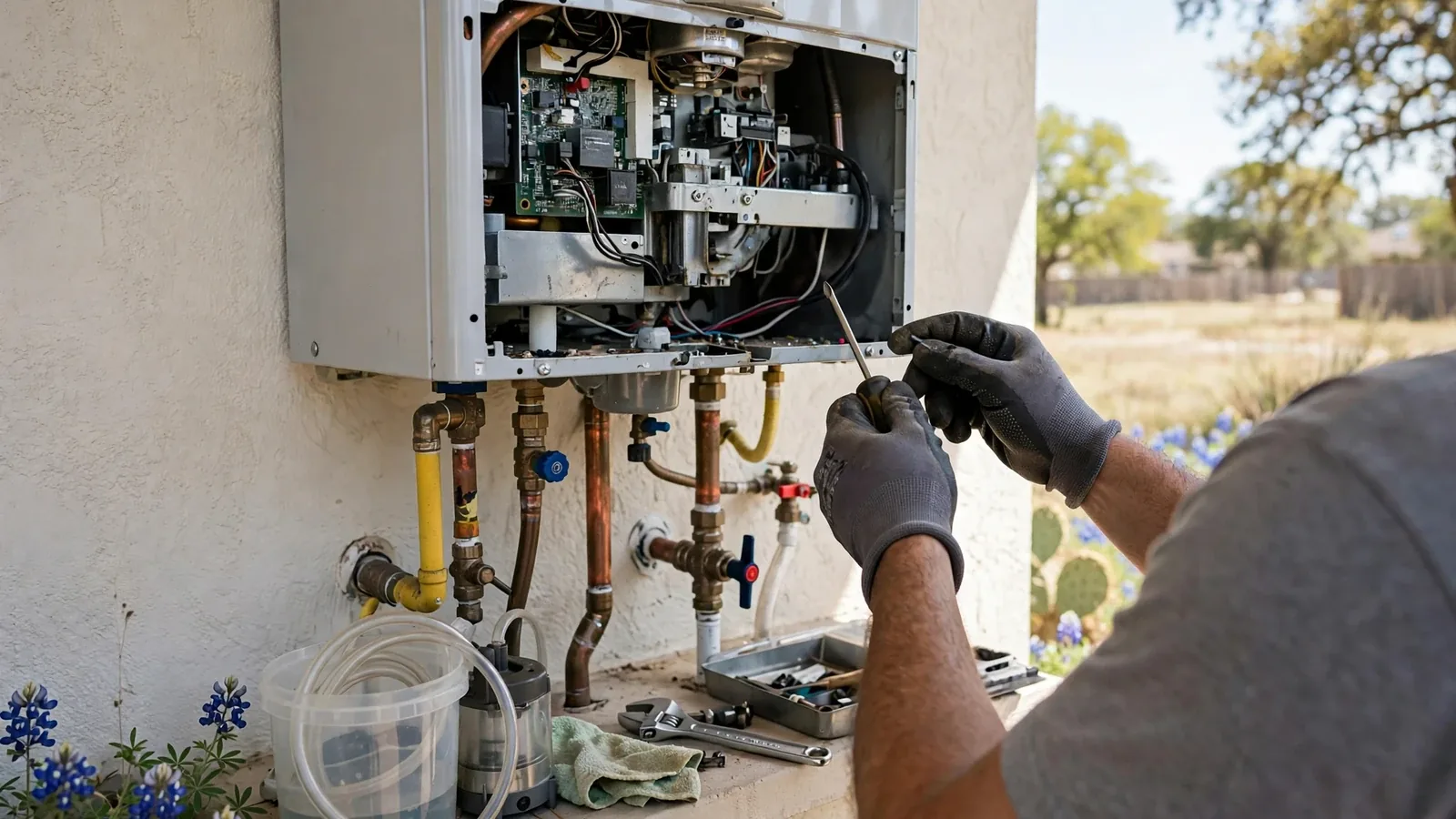
Why a tankless unit needs flushing
Water carries dissolved minerals, and heat makes those minerals drop out as scale. Inside a tankless heater, scale coats the heat exchanger, the small passages where the water picks up heat. A coated exchanger heats less well, and the unit works harder to deliver the same temperature.
The signs show up in daily use. You may see error codes, hot water that runs cooler than it did, a unit that cycles on and off, or flow that feels weaker. A flush does not fix every one of those, but scale is a common cause that is easy to rule out.
The U.S. Department of Energy says tankless water heaters last about 20 years. Regular flushing is one of the ways to give a unit its full life, and the manual tells you how often. We do not give a schedule number here because the right interval depends on your model and your water.
What you need before you start
- The manufacturer's manual, for the exact descale method and any warnings.
- A small submersible pump, often called a utility pump.
- Two washing-machine style hoses with the right fittings.
- A bucket large enough to hold the circulating solution.
- White vinegar or the descaler your manual names.
- A flat screwdriver or the key for the isolation valves.
- Rubber gloves and eye protection.
Check the manual before you buy anything. Some makers approve vinegar, some call for a specific descaling product, and some say not to use certain acids. Use what the manual says, not what a video says.
Safety steps that come first
Before you touch a valve.
Turn off the power or the gas supply to the unit and let it cool. Hot water inside the heater and pipes can scald. If you smell gas at any point, stop, leave the house, and call Intermountain Gas at 800-548-3679 and 911 from outside.
Electric and gas units differ here. On a gas unit, shut the gas valve and unplug the power cord if there is one. On an electric unit, turn off the breaker. Never run the pump with the unit powered on.
Also close the cold water inlet isolation valve and the hot water outlet valve. Open a hot faucet in the house to relieve pressure, then proceed.
How to flush it, step by step
Close the isolation valves.
Turn the cold inlet and hot outlet valves so water cannot enter or leave the heater.
Attach the hoses.
Connect one hose from the pump to the cold service port and the other from the hot service port back into the bucket.
Fill the bucket.
Add the vinegar or descaler from the manual, with the amount and dilution it states.
Open the service ports.
Turn the port valves to open the flow path through the heat exchanger.
Run the pump.
Circulate the solution for the time the manual gives. Many manuals name a time, so follow yours.
Rinse with fresh water.
Drain the solution, close the hot port, and flush with clean water until it runs clear.
Restore and test.
Close the ports, open the isolation valves, bleed air from a hot faucet, then restore power or gas and check for leaks.
Clean the inlet water filter if your unit has one. It is a small screen that catches debris, and the manual shows where it sits. Put everything back the way you found it, and write the date somewhere you will see it.
What if there are no isolation valves
Some older installs skip the service valves. Without them, draining means cutting into the water lines, and that is a plumbing job. A licensed plumber can add isolation valves with hose ports, which also makes every later flush simple.
Our tankless water heater service page covers valve kits and the other parts that make a unit easier to maintain. If the unit shows the same error after a good flush, the problem is probably not scale, and a service visit is the right next step.
| Situation. | DIY flush. | Call a plumber. |
|---|---|---|
| Valves and ports already installed. | Reasonable with the manual. | If you are not comfortable. |
| No isolation valves. | Not advised. | Yes, to add valves. |
| Gas smell or leak. | Never. | After utility clears the home. |
| Error codes persist after flushing. | No. | Yes, for diagnosis. |
| Visible leak at the unit. | No. | Yes. |
Scale control and water treatment
If the manual interval feels short because scale keeps coming back, the water itself may be the cause. A water test shows what is in your tap, and a plumber can then size a treatment system. Our water softener and filtration page covers the options.
Cost drivers for service follow the work. They include whether valves must be added, how clogged the exchanger is, whether parts are worn, and the time for a full flush and a test. We give a clear price before work starts, and the real number comes from a call.
Eagle, ID water and your tankless heater
Water in Eagle, ID comes from Veolia Water Idaho, from the City of Eagle's own water system, or from a private well in some outlying areas. Veolia uses groundwater wells, and which supply serves your home depends on the address. We do not know your tap's hardness, and neither should you guess.
Ask your water utility for its annual water quality report, or test your tap. That result tells you how fast scale is likely to build and whether a softener makes sense in Ada County homes like yours. It also helps you read the manual's flush interval with some context.
The Department of Energy puts tankless life at about 20 years. A home in The Shores or Two Rivers built from 2006 forward could have a tankless unit that is already well into that span, so a flush and a condition check now is sensible.
Common questions
How often should I drain a tankless water heater?
Check your manual. The right interval depends on the model and on your water, so we do not give a single number.
Can I use vinegar to flush a tankless heater?
Many manufacturers allow white vinegar, and some name another descaler. Use the product your manual lists, and rinse well afterward.
Can I flush a tankless heater in Eagle, ID without a plumber?
Yes, if the unit has isolation valves and service ports and you follow the manual. Ask your utility, Veolia Water Idaho or the City of Eagle, for a water quality report to judge scale.
Do I need to turn off the gas?
Yes. Shut off the gas valve or the electric breaker before you flush, and let the unit cool. If you smell gas, leave and call the utility and 911.
What if the error code returns after flushing?
Scale was not the cause, or the unit has a failing part. Call (208) 679-8357 for a service visit.
Do you service tankless heaters in Star and Garden City?
Ask when you call. We cover Star and Garden City too, and each page lists what applies there.
If your unit lacks valves or still shows an error after a flush, call (208) 679-8357 and we will book a visit.
Call (208) 679-8357Standards and sources
Plumbing work in Idaho follows the state plumbing code, which is based on the 2015 Uniform Plumbing Code (UPC) with state amendments in IDAPA 24.39.20. Permits and licenses come from the Idaho Division of Occupational and Professional Licenses (DOPL), not the city.
- U.S. DOE: Which Water Heater Is Right for You (federal agency)
- Intermountain Gas Company: emergency information (utility)