
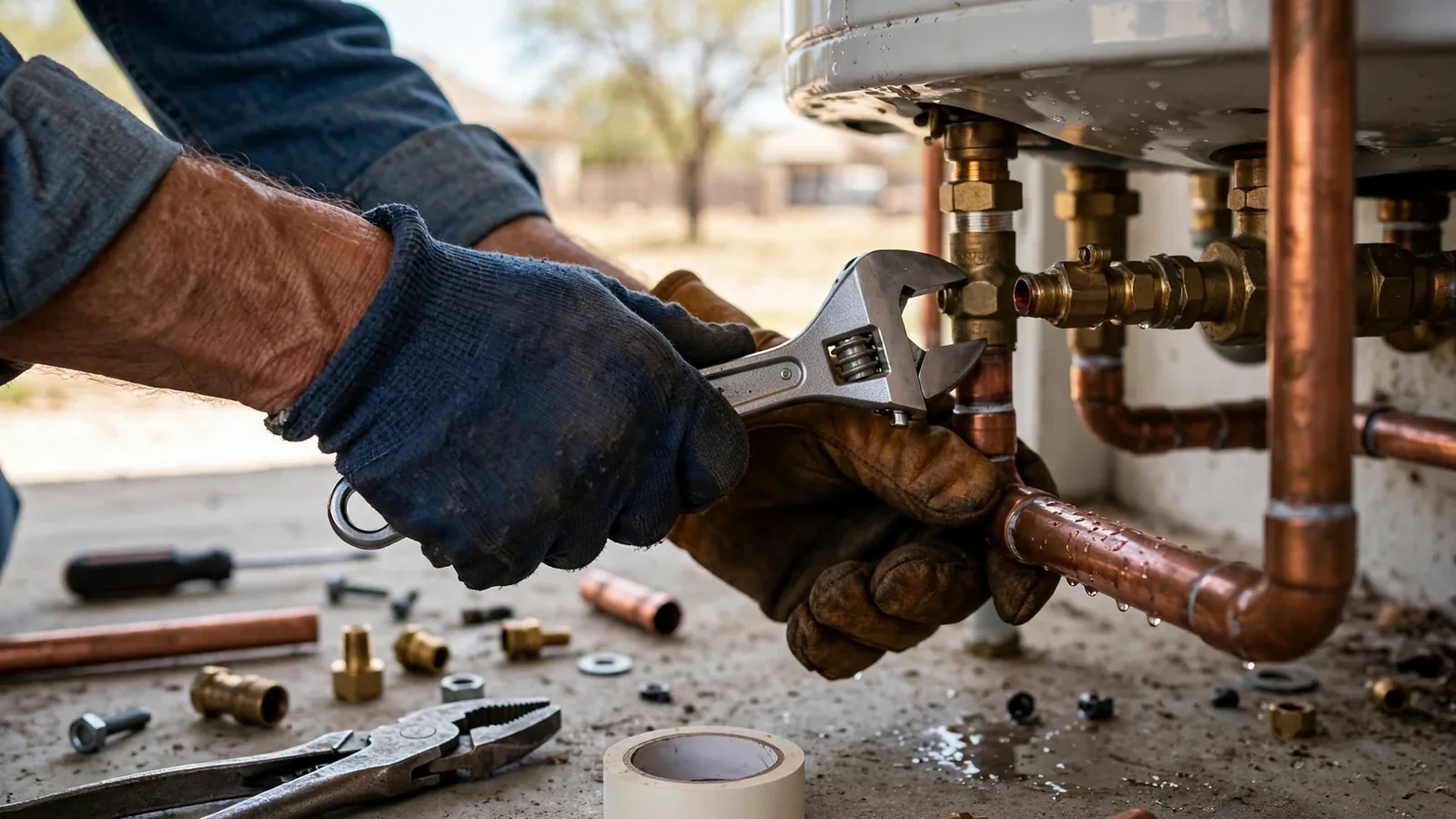
Type K, L and M: what the letters mean
The letter tells you wall thickness, not pipe size. A half-inch Type K pipe and a half-inch Type M pipe have the same outside diameter, so they take the same fittings. The K wall is thicker and the pipe is heavier. More metal between the water and the outside matters when a pipe is buried or under stress.
Here is how the three types compare in everyday trade use. These are general conventions, so the pipe maker's data sheet and the code have the final word.
| Type. | Wall. | Common use. | Good to know. |
|---|---|---|---|
| K. | Thickest. | Buried service lines and heavy-duty runs. | Sold as rigid sticks and soft coils. |
| L. | Medium. | Interior water supply and many repairs. | The usual middle choice for house plumbing. |
| M. | Thinnest. | Light-duty interior supply. | Lighter to handle, with less metal to wear through. |
Thinner does not mean bad. The job decides the type. A short interior run does not need the wall a buried line needs, and a buried line should never be the thin pipe.
Reading the copper you already have
Walk to the water heater or the main shutoff and look at the pipe. Copper from a pipe maker usually carries a printed stripe along its length, and the color is a trade code. Green is Type K, blue is Type L and red is Type M. Print wears off with age and hides under tape or insulation, so do not count on it.
Size confuses people. Copper is sold by nominal size, so a half-inch pipe measures about five-eighths of an inch across the outside. Measure the outside with calipers or a tape, then ask the supply counter to match it. A wrong guess gives you a fitting that will not seat.
- Bright salmon color is clean copper, and dull brown is just oxidation.
- Green or blue crust at a joint points to a slow weep, so wipe it dry and watch it.
- Beads of water along a cold pipe are usually condensation, not a leak.
- A stain on the drywall below a pipe run means the wall needs opening to see the cause.
Couplings, elbows, tees, unions and adapters
Fittings are the parts that join pipe and change its path. Knowing the names lets you read a parts list or follow a plumber's explanation.
Coupling.
Joins two straight pieces. A slip coupling has no internal stop, so it slides all the way over a repair gap.
Elbow.
Turns the pipe 45 or 90 degrees. A long-radius elbow gives water a gentler turn.
Tee.
Branches a line into a second run. A reducing tee steps down to a smaller branch.
Union.
Comes apart without cutting. You see unions at water heaters so a tank can be swapped without redoing the pipe.
Adapter.
Changes copper to a threaded end, so the pipe can meet a valve, a hose bib or a steel nipple. Plumbers often add a dielectric fitting where copper meets steel.
Sweat, press or push-to-connect: choosing a joint
There are three ways to join copper in a home. Each has a place, and each fails in its own way when done carelessly. This table sets them side by side.
| Joint. | How it holds. | Tools. | Where it fits. |
|---|---|---|---|
| Sweat (solder). | Heat pulls solder into the gap between pipe and fitting. | Torch, flux, lead-free solder, cloth. | The long-time standard for permanent joints. |
| Press. | A battery tool crimps the fitting over a sealing ring. | Press tool with the right jaws. | Tight spots near wood framing, with no open flame. |
| Push-to-connect. | A grip ring and O-ring hold the pipe once it is pushed in. | Tubing cutter, deburring tool, depth gauge. | Quick repairs and pipe that will not dry. |
Sweating needs a dry, clean pipe. Any water left in the line turns to steam and blows holes in the solder, which is why plumbers drain the line and scrub the copper bright before heating.
Push fittings look easy, and the ease is the trap. The pipe end must be cut square, deburred and pushed to the marked depth. Makers differ on where push fittings may be used, such as inside a closed wall, so read the label and the instructions before you trust one.
Copper or PEX: how the choice gets made
PEX is flexible plastic tubing. It needs fewer fittings because it bends around corners, and it can expand a little when water inside it freezes, though it is not freeze-proof. It must stay out of sunlight, and it is not meant to touch hot flue parts.
Copper is rigid, tolerates heat near a water heater and does not sag between supports. It costs more labor to join well, and it can develop pinholes as it ages. Neither material is right for every house, and the code and the maker decide where each may go.
A custom home built between 2006 and 2019, like those in The Shores or Two Rivers, could have either material. Look at the pipe before you assume. If copper is failing in several places, patching becomes a habit, and whole-house repiping is the question to bring to a plumber.
Pinhole leaks and what to ask about them
A pinhole leak is a tiny hole in a copper wall. It shows up as a green stain, a damp spot on drywall or a fine mist behind a wall. The causes are mixed, and finding the one at work means looking at the pipe, not guessing.
Water chemistry can play a part. We do not know what is in your water. Your supplier might be Veolia Water Idaho, the City of Eagle or a private well, depending on the address. Ask your water utility for its annual water quality report, or have your tap tested.
One pinhole can often be cut out and closed with a coupling. Several pinholes in different rooms point to wear through the whole system. If water is spraying or a stain is growing, shut the main valve and call for burst pipe repair, which our 24/7 dispatch line handles.
To check for a leak you cannot see, try the EPA meter test. Note the meter reading, use no water for two hours, and read it again. If it moved, you probably have a leak somewhere.
A checklist before you cut into a copper line
- Shut the water off at the main valve inside the house and confirm it holds.
- Open a faucet at the highest point and another at the lowest to drain the line.
- Identify the pipe size and type, and buy fittings that match.
- Cut square with a tubing cutter, then deburr and clean the ends bright.
- Match the joint type to your tools and your skill, not to the fastest option.
- Turn the water on slowly and watch each joint for a bead of water.
Stop and call a licensed plumber if the main valve will not close fully, if the pipe is crusted for a foot or more beyond the leak, or if the run sits behind a finished wall. Those are signs the problem is bigger than the visible spot.
Copper work in Eagle, ID: licensing and permits
Idaho's State Plumbing Code rests on the 2015 Uniform Plumbing Code (IDAPA 24.39.20), the rulebook behind copper work in Eagle, ID, including which materials a job may use. Past that we will not guess. Rules differ from job to job, so DOPL at 208-334-3233 is the right call for your specific project.
The state, not the city, hands out plumbing permits, through its Division of Occupational and Professional Licenses (DOPL). A person may pull one for work on their own primary or secondary home but not for a commercial building. Nothing from the city or county building office replaces it, and it lapses 365 days after you buy it or after its last inspection.
Anyone can look up a plumber's licence on DOPL before work begins. Our licensed and insured plumbers cover Eagle in Ada County and also Star and Garden City, under the same state code. If you do your own copper work, DOPL takes the inspection request by phone or online.
Common questions
What is the difference between Type L and Type M copper pipe?
Type L has a thicker wall than Type M, while both share the same outside diameter. That means they take the same fittings. L gives more margin against wear, and M is lighter and easier to handle.
Can copper be connected to PEX?
Yes, with fittings made for the transition, such as push-to-connect or crimp adapters rated for both materials. Check the label for the temperature and pressure ratings before you buy.
Is soldering copper a good project for a homeowner?
It can be, with practice on scrap pipe first. The risks are fire near framing and a joint that weeps later because the pipe was damp or dirty. If you are unsure, a push or press joint by a licensed plumber is safer than a rushed solder joint.
How do I know if a green stain on my pipe is a leak?
Wipe it dry and check it again after a day. If a bead of water returns, the joint is weeping and needs repair. If it stays dry, the stain may be old residue, but keep watching it.
Do I need a permit to repair copper pipe at my home in Eagle, ID?
The permit comes from DOPL and never from the city. An owner can buy one for their own residence. What a particular job needs varies, so call DOPL at 208-334-3233 before you pick up a torch.
Does a pinhole leak mean all my copper needs replacing?
Not always. One pinhole can be cut out and fixed with a coupling. Repeated pinholes in different spots suggest the whole system is wearing, and that is when repiping is worth pricing.
If you found a stain, a mist or a pipe you cannot identify, tell the dispatcher what you see on (208) 679-8357.
Call (208) 679-8357Standards and sources
Plumbing work in Idaho follows the state plumbing code, which is based on the 2015 Uniform Plumbing Code (UPC) with state amendments in IDAPA 24.39.20. Permits and licenses come from the Idaho Division of Occupational and Professional Licenses (DOPL), not the city.
- Idaho DOPL plumbing FAQs (state agency)
- IDAPA 24.39.20 Idaho State Plumbing Code (state rule)
- U.S. EPA: Fix a Leak Week (federal agency)