
First question: is the water coming from your plumbing?
A wet basement is not always groundwater. A leaking supply line, a failed water heater, a cracked drain or a weeping fitting can all put water on the floor, and no sealer will stop any of them. Rule this out before anyone quotes you for foundation work.
Try the EPA meter test. Read your water meter, use no water anywhere in the house for two hours, and read it again. If the numbers moved, you probably have a leak somewhere, and a leak detection visit can pin down where.
- Water appears on a dry, calm day with no rain.
- The wet spot sits under a pipe, a fixture or the water heater.
- The meter moves while the house is quiet.
- A wall is damp only where a drain or supply line runs behind it.
Three places water comes from
Surface water is rain and snowmelt that runs toward the house and soaks in along the foundation wall. It is the most common cause and the easiest to fix.
Groundwater is water in the soil that rises with the season and pushes on the slab and walls from below and the sides. It is harder to fight, and it is why some houses have a sump pit.
Plumbing water is a leak from your own pipes. It can mimic either of the other two, which is why diagnosing comes first.
Fix the outside first
Most seepage problems start with water collecting beside the house. These are the steps that cost the least and do the most.
Check the grading.
Soil near the foundation should slope away from the wall. If it dips toward the house or has settled, water follows it in.
Clear the gutters.
Full gutters spill over the edge and dump water right at the footing. Clean them and make sure they are pitched toward the downspout.
Extend the downspouts.
A downspout that ends at the foundation soaks the same few feet every storm. Run it well away from the wall.
Look at window wells.
A window well that fills with water or debris sends it straight against the glass and frame. Clear it, and check that the drain at the bottom works.
Aim the sprinklers.
Spray that hits a wall or soaks the soil beside it keeps that ground wet all summer.
Interior drains and a sump pit
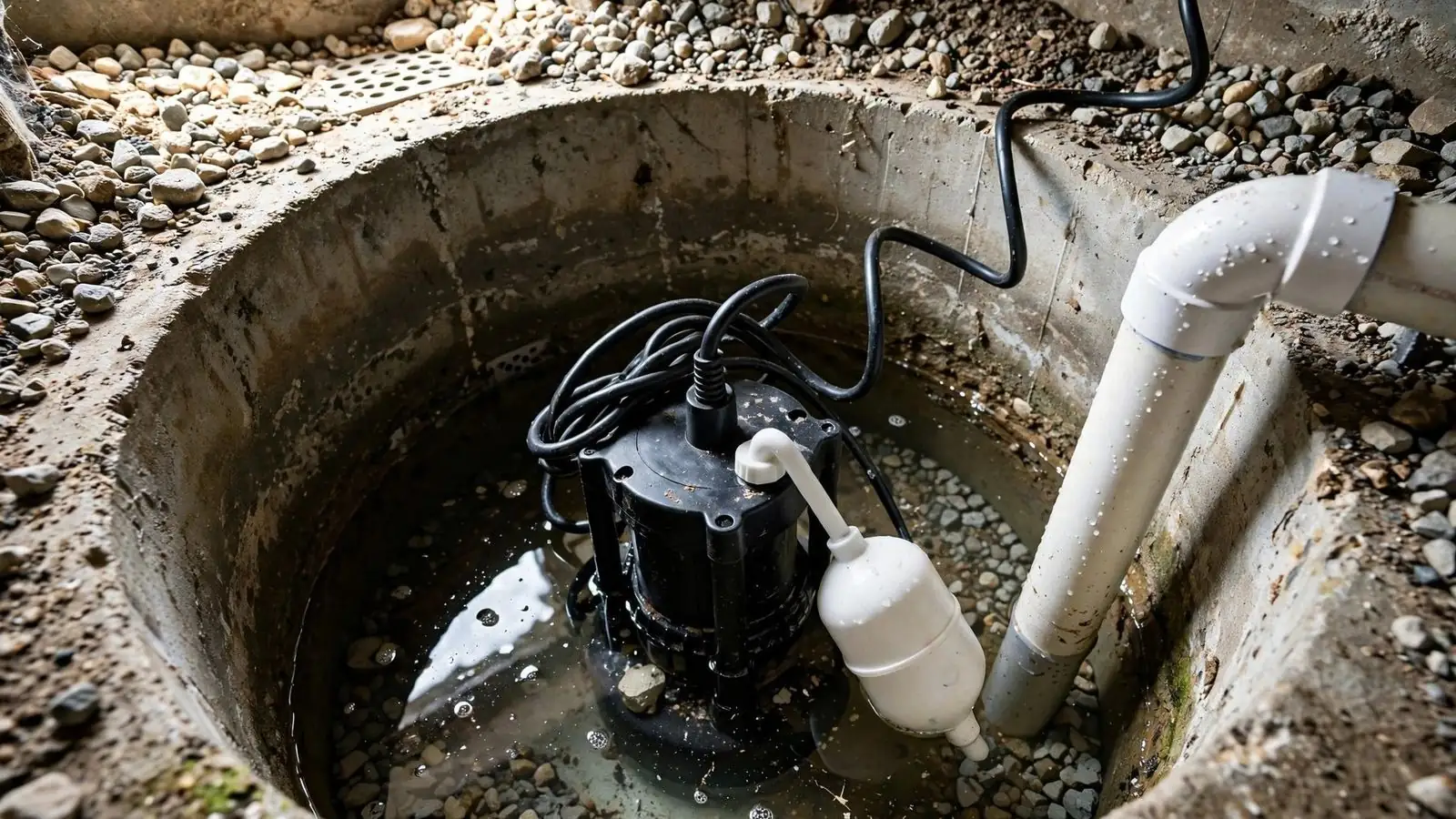
When water still gets in after the outside is sorted, the next step is to give it somewhere to go. An interior drain runs along the base of the wall under the slab edge and carries water to a sump pit, where a pump sends it out of the house.
That system needs a pump, a check valve, a discharge line, and a battery backup if the power fails. Our guide to sump pump repair work covers what we fix on the plumbing side. Cutting the slab and laying drain pipe is a foundation job, not a plumbing one, so ask who is responsible for each part before you sign.
What each method does and where it falls short
People often ask which fix to buy first. This table lays out what each one does and where it stops.
| Method. | What it does. | Limit. | Who does it. |
|---|---|---|---|
| Grading and downspouts. | Keeps surface water away from the wall. | Does nothing for groundwater. | You or a yard contractor. |
| Gutter repair. | Stops roof water at the footing. | Needs regular cleaning. | You or a roofer. |
| Paint-on sealer. | Slows damp on the wall surface. | Fails under water pressure. | You or a painter. |
| Interior drain and sump. | Collects and removes water that gets in. | Does not stop water entering the wall. | Foundation contractor and plumber. |
| Exterior membrane. | Blocks water at the outside face of the wall. | Needs excavation, so call 811 first. | Foundation contractor. |
Why paint-on sealers disappoint
A masonry sealer is a coating you brush on the inside of the wall. It can slow dampness and it can hide a stain, but it sits on the wrong side of the water. When pressure builds from outside, the coating peels off the wall.
Use a sealer for light dampness once the outside is fixed. Do not use it to solve a leak that shows up after every storm.
What a plumber can and cannot do about a wet basement
We find plumbing leaks, repair supply and drain lines, and install or repair sump and ejector pumps and their discharge piping. We do not regrade your yard, replace your gutters, or excavate and coat a foundation wall. Those belong to a yard contractor, a roofer or a foundation contractor.
We give a clear price before work starts on the plumbing part of any job in Eagle, ID, and we say plainly when the cause is outside our trade. Insurance usually treats sudden accidental damage differently from slow seepage, so read your policy before you file anything.
Newer builds in Star and older homes in Garden City
A newer house in Star, where the population climbed 91.9 percent from 2010 to 2020, may have no basement or a shallow one. Check your plans before you plan a fix. If you want a hand with plumbing there, our plumber in Star page says what we cover.
Garden City's housing stock runs from the postwar decades through the 1980s, with the river path passing Plantation Island. Older homes may have older drain and supply lines too, which makes the plumbing check even more worthwhile. See our plumber in Garden City page for that area.
River flooding history and sprinklers near foundations in Eagle, ID
Recurring Boise River flooding has been part of Eagle's history, even after Arrowrock Dam was built in 1915 and later dams followed. That does not tell you what your own yard does, since we have no verified groundwater data for any address. It is a good reason to look at drainage around an Ada County home before the wet season.
The Shores and Banbury Meadows both have pressurized irrigation, which means sprinkler lines run around many yards. A sprinkler head that sprays the foundation, or a buried irrigation line that leaks, can keep the soil beside a wall wet for months. If you have a basement in either neighborhood, check where your heads aim and watch for soggy ground near the house.
Many Eagle homes may not have a basement, and a slab house with a damp patch is a different problem. If you do have a below-grade room, call 811 before anyone digs around the foundation.
Common questions
How do you make a basement waterproof?
Start by finding the source. Fix grading, gutters, downspouts and sprinkler aim outside, then add an interior drain and sump if water still gets in. A plumber checks for pipe leaks, and a foundation contractor handles wall and slab work.
Can I waterproof a basement myself?
You can handle grading, gutters, downspout extensions and sprinkler aim yourself. Excavation and interior drain installation are jobs for a contractor, and any dig needs a call to 811 first.
Is a wet basement always groundwater?
No. A leaking pipe, a failed water heater or a bad drain can put water on the floor. The EPA meter test tells you whether your plumbing is leaking.
Do basement waterproofing paints work?
They help with light dampness on a wall once the outside is fixed. They do not hold back water pressure, so they are the wrong fix for a wall that leaks after rain.
Do many homes in Eagle, ID have basements?
Many Eagle homes may not have basements, so check your plans or look for a below-grade room. If you do have one, watch the sprinklers and gutters, since The Shores and Banbury Meadows both have pressurized irrigation.
Will a sump pump keep my basement dry?
It removes water that collects in the pit, which helps a lot. It does not stop water from entering the wall, and it needs power or a battery backup to run.
If you suspect a pipe and not the foundation, call (208) 679-8357 and we will help sort it out.
Call (208) 679-8357Standards and sources
Plumbing work in Idaho follows the state plumbing code, which is based on the 2015 Uniform Plumbing Code (UPC) with state amendments in IDAPA 24.39.20. Permits and licenses come from the Idaho Division of Occupational and Professional Licenses (DOPL), not the city.
- U.S. EPA: Fix a Leak Week (federal agency)